

(This series is an adaptation of a talk I gave at Hutchmoot UK 2025. I’ve finally gotten around to posting it here, partly as prelude to a soon-coming series on bodies as iconography.) Part 1, Part 2
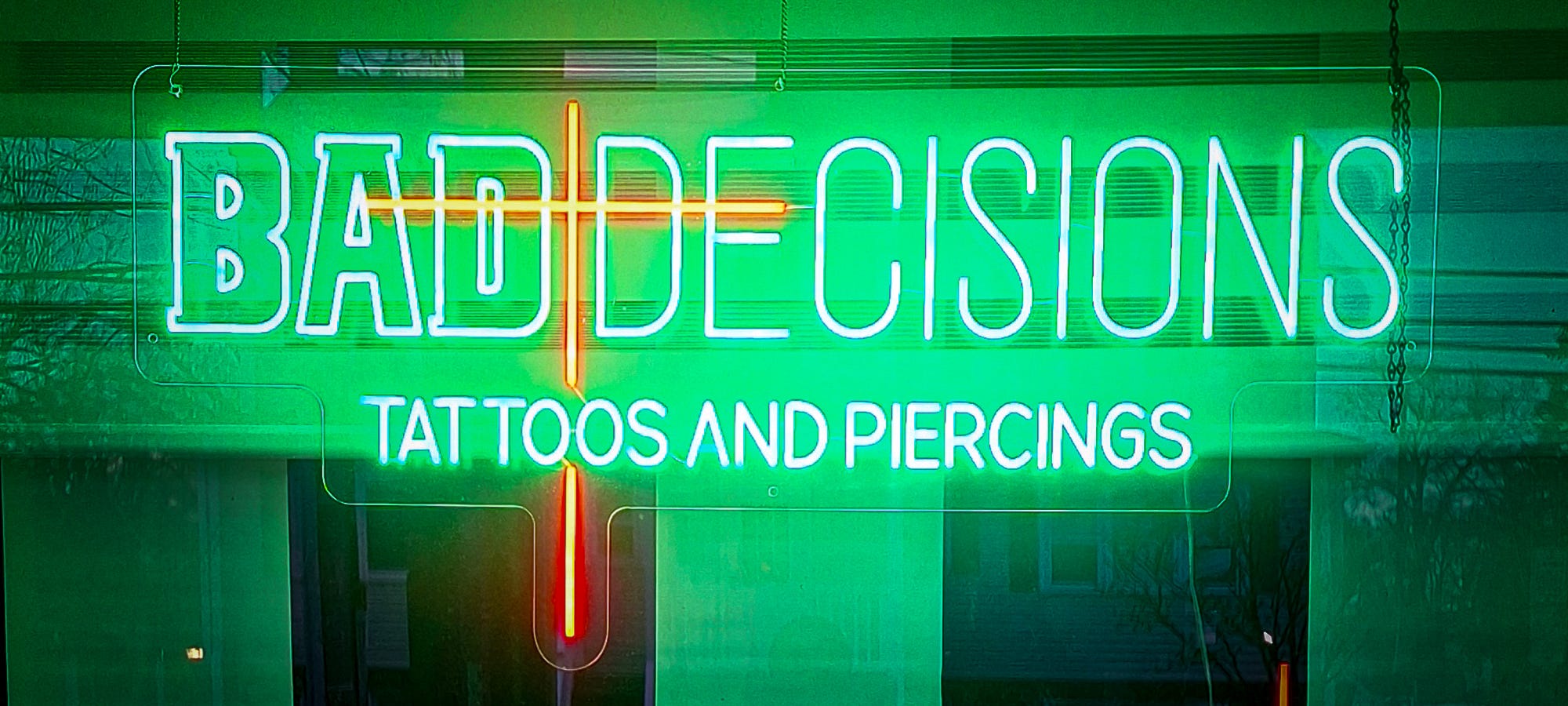
Here, I want to discuss the concept of our bodies as a canvas for storytelling.
Three summer ago, I attended a race day in Newmarket with some acquaintances. I was sitting with one of them on the grass near the finish line between races. She was bare-armed, in a sundress, and had a motorcycle tattoo on her shoulder. I asked, “Do you ride?”
She said, “no,” and hesitated.
I could tell that ink weighed heavily. She told me her brother was a rider and had died in a wreck a few years earlier. Her tattoo was her memorial to him.
Little did I know, a few months later, my sister would pass in a car wreck. This friend was someone I was able to talk to during that time—all because her tattoo was the gateway to a story.
Dr. Joseph Pierre, a healthcare professor and co-author of a study on skin art and psychiatric practice, says, “Tattoos are often telling an important story through art that isn’t expressed in words.”
Through tattoos, bodies bear marks of history in a permanent and visible way. Wrinkles, lines, and other physical conditions also tell the story of a life. But body marking possesses the capability to reveal that which is hidden. It is a chosen revelation about one’s past or one’s thought processes. Even the most impulsively gotten tattoo is a time capsule, a memento temporum, connected to a specific time, place, and state of mind.
Matthew Lee Anderson speaks of the idea of a “tattoo narrative,” similar to a “conversion narrative”—an account of significant change, transformation, or development bound within a chronological framework.
In his book, How to Inhabit Time, James K.A. Smith relates the story of his daughter getting a tattoo against parental prohibition. The tattoo on her arm turned out to be the GPS coordinates of the house she had been raised in—and this was a way of inhabiting time and remembering the place and moments by which she’d been shaped.
Body markings not only commemorate history but tell stories and express important identities to the world. Tattoo artist Nick F, who also goes by Tahini and specializes in Hebrew and Jewish-themed tattoos, said:
In a world…where it is beneficial for us to try and invisiblize our Jewishness, the act of having and receiving Judaica tattoos creates radical visibility… It is a way of engaging the world and allowing ourselves to be seen by our potential peers, while also welcoming the challenge of bigotry and confronting antisemitism head-on.
The deliberate marking of our bodies is an outgrowth of a desire to provide a sense of coherence, unity, and meaning to our lives. These permanent markers, like the stela of ancient civilizations, give a sense of history, movement, and direction. Israel raised stone markers in the Promised Land to remember not only where they had come from, but where God promised to take them. In a constantly shifting world, the thing we are always left with is our bodies and the marks we have made on them—most potent reminders.
As much as we think of tattoos as expressions of a desire for permanence, technology today makes it possible to get impermanent tattoos or to remove tattoos altogether.
The founders of a company called Ephemeral pioneered a kind of ink designed to break down over time due to the body’s natural processes. Their tattoos fade in nine-to-fifteen months.
Interestingly enough, some take issue with the very idea of an impermanent tattoo. An individual with over 100 tattoos told the New York Times, “I like the fact that they are permanent because they are part of me. They represent a moment in time, and I like living with all my history.” She equated tattoos she no longer cares for to scars, a remnant of bad choices made when one was younger.
Other famous tattoo artists take issue with companies like Ephemeral for artistic reasons. Keith McCurdy, who’s been creating tattoos for almost twenty years, argues that Ephemeral “seems to move the needle backward…” He says, “A tattoo designed not to last potentially decreases the value of this art form, which historically struggled to gain the monetary value of other forms of art like painting or sculpture.”
Another artist, Sweet Sue, who inked for over two decades before losing her battle with cancer in 2025, said, “We spend our entire careers trying to figure out the mystery of how to get nice, clean, solid lines to lay in the skin perfectly and stay forever. It makes me want to cry to see all this hard work just disappear.”
Despite such hand-wringing over impermanent tattoos, some see the removal of tattoos as an important evolution in their story.
Model and socialite Angela White, better known as Blac Chyna, posted a video of her getting a tattoo of Baphomet removed two days after sharing her story of conversion and baptism. “Thank you, God, for saving me,” she wrote. “I’m sending all this energy back to the owner.” She also had other body modifications, including lip filler and posterior implants, removed as part of her journey.
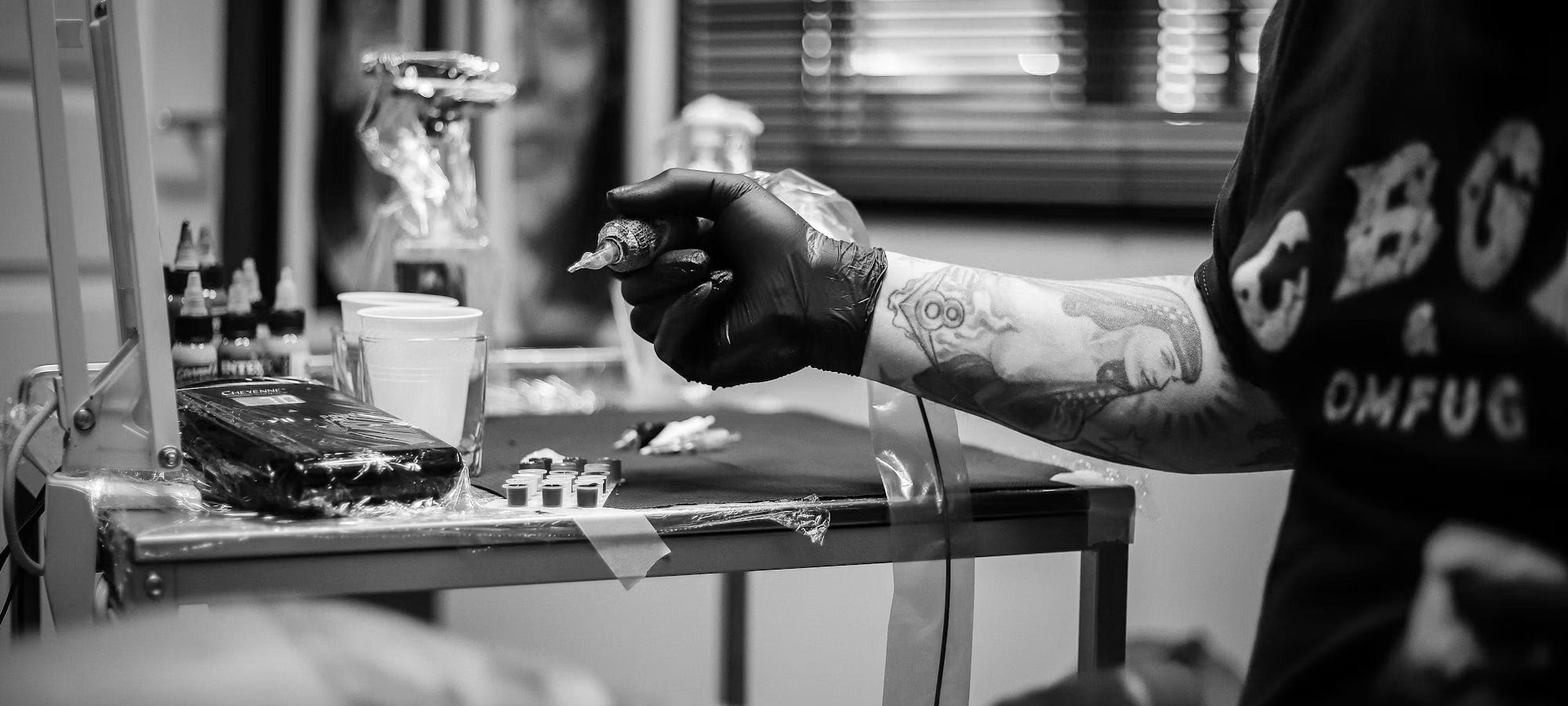
However you feel about the validity of permanent vs. impermanent tattoos, one thing is clear: our bodies are a mechanism for storytelling. And storytelling does not just exist for the sake of self, but for the sake of others. We live in a society in which those outside of ourselves are always interpreting our presentation of self—from the clothes and jewelry we wear to the way we style our hair and mark our bodies.
A few years ago, a friend of mine came back from a trip to Las Vegas with a Vegas Golden Knights hoodie for me. I love that hoodie. It’s probably the most comfortable item of clothing I have. However, almost every time I wore it for the first few months, I’d get shoutouts from passersby who assumed I was a Golden Knights fan. And I’m not; I don’t really care for hockey that much. But by me wearing that hoodie, people assume something about my story, about who I am.
Hence the fascinating nexus between what we intend by a thing and what our society, our community, understands that thing to be. There is a social dimension to all of our self-expression. We are the beauty or the terror in the eyes of our beholders. The storytelling that we do with our bodies is a significant affair.
Finally… body art as a process of reclamation, incarnation, and possibly redemption.
I think it’s fairly basic to state that we ourselves, our naked forms, are an image of God—we reflect him in this world by maintaining a form that he bore when he entered this world. And like him, we image that which is important to us by what we mark and allow to be marked on our bodies.
In Isaiah (49:16), the Lord engraves the children of Israel on his palms as proof that he would never forget them and would, one day, restore them.
The resurrected Lord identifies himself by the marks left where metal tore his skin. Yes, in a perfect, renewed, restored, and presumably flawless body, he willingly retains the marks of a criminal justice and criminally unjust system. We could imagine that, if first-century criminals routinely returned from the dead following Roman crucifixion, society would tell them they should hide the accompanying marks so that they could not be identified as somehow inferior.
For Christ, the very icon of redemption, the marked body is not a flaw, not inferior, but a way of identifying history overcome by grace. The marks are a feature not a bug. Which begs the question: Will glorified bodies retain their tattoos?
I wonder if the tattoo, and its process of breaking and healing, has itself become an avenue of small iconography and incarnation, a minor representation of a process embedded in an eternal and ever-evolving story.
Robert Anthony Orsi, a scholar of American history and Catholic studies, writes:
The materialization of religious worlds includes a process that might be called the corporalization of the sacred. I mean by this the practice of rendering the invisible visible by constituting it as an experience in a body—in one’s own body or in someone else’s body—so that the experiencing body itself becomes the bearer of presence for oneself and for others.
For some, the act of tattooing might be…
A way of conforming one’s body to Christ’s
A way of reclaiming the historical norm of constant visible reminders of transformation in a world where much beyond our bodies is transient and shifting
A way of “corporalizing”—that is, incarnating—an important aspect of one’s story or a larger, mythic metanarrative
Far from what its detractors might suggest, the tattoo is not cultural “gibberish.” It is an expansion of iconography, those signs which both conceal and reveal deeper realities. Some researchers have gone so far as to suggest that a lack of emphasis on iconographic and liturgical practices in modern churches have left a void that the logic of the tattoo has inevitably filled.
Matthew Lee Anderson writes:
This is the paradox, then, of the cultural ascension of tattoos: While tattoos mark a desire for significance within a destabilized world, they are a live option for most young people precisely because we [the church] have not escaped the clutches of the consumerism and the individualism that are so often criticized.
Deeper meanings and hidden stories are worth holding before our eyes and within ourselves. A friend who has as many tattoos for as many years as she’s been alive told me about a woman who gets a new flower tattoo to mark every year that she’s sober. Sometimes, her kids, the beneficiaries of her choice to abstain from alcohol, pick out the flower.
This expansion and articulation of iconography can be seen in the penultimate act of Flannery O’Connor’s “Parker’s Back.” You’ll recall: Parker is at his wits’ end with his over-zealous and judgmental wife. Becoming increasingly depressed and disillusioned, and unable to bring himself to leave her, he obsesses over the last bit of significant real estate on his body—his back, which remains untattooed.
He visualizes having a tattoo put there that Sarah Ruth would not be able to resist—a religious subject.
Something that would show Sarah Ruth his commitment to the things that were important to her in the way that he best knew how to show it.
Later, he finds himself on holy ground, having crashed his tractor into an old tree, setting it on fire, and losing his shoes in the process. He is spurred to unthinking action, blindly driving to a tattoo artist fifty miles away.
“Let me see the book you got with all the pictures of God,” he demands.
He is convinced that the face of God will call to him out of the catalog. And the face that calls is “the haloed head of a flat stern Byzantine Christ with all-demanding eyes.” Parker demands that this particular face, in all its intricate detail—detail which presages an assemblance of pain—be tattooed on his back. The face is one emblematic of overwhelming commitment, the only adequate answer to Christ’s call.
Once the tattoo is complete, Parker goes through a cycle of doubt, worry, denial, and finally resignation.
The eyes in the reflected face continued to look at him—still, straight, all-demanding, enclosed in silence.
The eyes that were now forever on his back were eyes to be obeyed. He was as certain of it as he had ever been of anything. Throughout his life, grumbling and sometimes cursing, often afraid, once in rapture, Parker had obeyed whatever instinct of this kind had come to him...
The first instance of this kind of irrefusable call to some kind of obedience occurred when Parker’s spirit is raptured at the sight of the tattooed man at the fair when he was fourteen. He had, in some way, obeyed that pursuit of wonder and rapture all his life. And that pursuit finds its apex in Parker compulsively marking the face of God on his body.
Now he follows a compulsion once again. He goes home to face his wife.
Shockingly, but not surprisingly, Sarah Ruth cannot see the light. She rages against Parker’s new tattoo. She can see neither the God in him nor the God on him and accuses him of idolatry. “I can put up with lies and vanity, but I don’t want no idolator in this house!” she says.
…she grabs the broom and begins to thrash him across the shoulders with it… Parker sits there and lets her beat him until she nearly knocks him senseless and large welts form on the face of the tattooed Christ…
Parker staggers away from the house and we last see him in the yard, leaning against a tree.
In the end, he becomes an image, an icon—a living picture of what he desperately sought to reflect with his body. We are left to wonder if, by that last bodily sacrifice and violent rejection—if by his messy attempt to incarnate God on and in his body—he was finally redeemed.
This, for me, is at the heart of the questions surrounding not only tattoos but marking and adorning our bodies in any way. Such acts are inherently aspirational pursuits. We are trying to pin something down, to both conceal and disclose—a history, a choice, a dream, a commitment, a story, a transformation—something that is bigger than the ink itself.