

(This series is an adaptation of a talk I gave at Hutchmoot UK 2025. I’ve finally gotten around to posting it here, partly as prelude to a soon-coming series on bodies as iconography.) Part 1
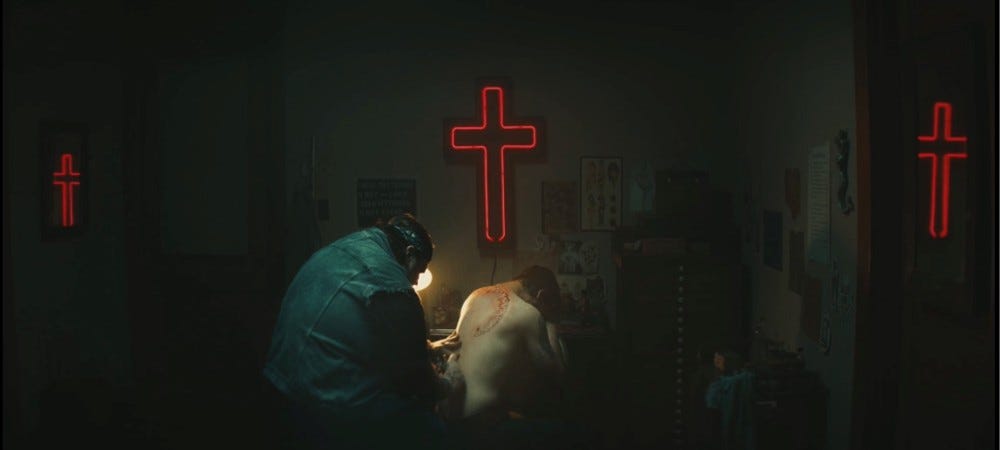
I think Flannery O’Connor and I are very alike. I am not, unfortunately, as good of a writer as she was. But I can say that Flannery, like me, did not have any tattoos. And yet she wrote this violently insightful story—“Parker’s Back”—about a worldly Southern man who wants to have nothing to do with God or good morals and finds his only sense of enchantment, rapture, or wonder, first in the presentation of a tattooed man, and then by getting into tattoos himself. I like to think that, as she was writing this story, she did a lot of research and reading and talking to people with tattoos and a fair amount of googling as I did.
“Parker’s Back” provides a compelling framework for exploring the whys and wherefores of body art, especially for religiously interested people and people interested in the presentation of the body as a reflection of deeper truths and realities.
The titular character, O.E. Parker, first sees a man covered in tattoos at a fair when he’s 14-years-old. He is “filled with emotion, lifted up as some people are when the flag passes...” Before this time, O’Connor writes, he “had never felt the least motion of wonder in himself.” This feeling of wonder at the sight of images rippling across that man’s skin stays with Parker. He starts getting tattoos wherever he goes, beginning with an eagle perched on a cannon. He discovers that girls find his tattoos attractive, so he’s intent on getting more. He also starts getting into fights and drinking. Parker’s mother, concerned for his soul, attempts to drag him to a revival meeting, prompting him to run off and join the Navy. Within a few years, his entire body, with the exception of his back, is covered in colorful images. “Parker would be satisfied with each tattoo about a month, then something about it that had attracted him would wear off.” And he’d go get another one.
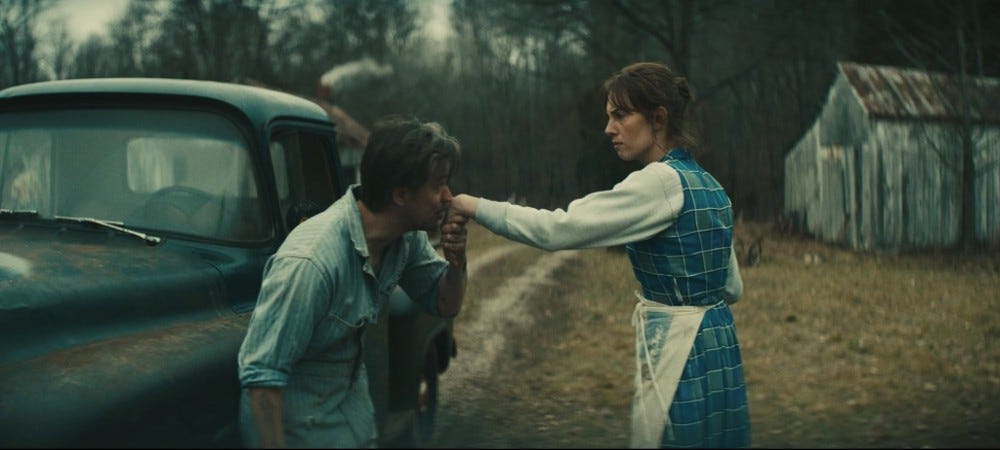
Discharged from the Navy and back home in Alabama, he meets Sarah Ruth—she is straight, strict, and stern. She hates almost everything about Parker—his lack of religion, his vanity, and especially his tattoos.
Naturally, they get married.
A few months later, Parker can’t make sense of how he let a woman like Sarah Ruth get ahold of him. He’s wild and unpoliceable; she is the police. Despite her consistent and vocal disapproval of his behavior (and of his very self), he finds himself stuck with her.
She’s pregnant. He descends deeper into disorientation and depression. He’s riding a tractor one day, pondering his life and how he can finally get Sarah Ruth to approve of him, when he crashes into a tree. The tree bursts into flames, he’s kicked out of his own shoes, and in a stupor of revelation, he realizes he needs to get the face of God tattooed on his back.
That’ll make Sarah Ruth happy. That’ll solve all his problems.
Parker’s obsession with tattoos makes for a very interesting character. We see his yearning in three forms. He yearns for a sense of wonder, a sense of connection, and a sense of order and unity.
When 14-year-old Parker sees that fully-tattooed man displaying the handiwork all over his body, he’s raptured in a way that he’d never felt before. Before then, O’Connor writes, “it had never entered his head that there was anything out of the ordinary about the fact that he existed.”
The images awakened him—the way they fit together and seemed just a tiny bit alive on their own. That man’s tattoos gave him something to be alive to.
Parker attempts to recreate this sense of awe, of wonder, in his own life. It is the sort of thing C.S. Lewis talked about—being surprised by joy and always seeking the re-creation, the re-experience of that surprise. The ink and needle are Parker’s gateway drug. But like most drugs, they lose their effectiveness after a while.
The effect of the tattoos…
…was not of one intricate arabesque of colors but of something haphazard and botched…
As the space on the front of him for tattoos decreased, his dissatisfaction grew and became general.
His dissatisfaction, from being chronic and latent, had suddenly become acute and raged in him. It was as if the panther and the lion and the serpents and the eagles and the hawks [all the animals tattooed on his body] had penetrated his skin and lived inside him in a raging warfare.
Here, we see, the outside and the inside are reflections of each other.
What’s Parker missing? When he meets Sarah Ruth, it appears that what he might be missing is connection and community. Things that hitherto he’s run from. Sarah Ruth is the first person he tells his real name to—O.E. Parker, Obadiah Elihue. She knows his secret, the identity he’s been hiding from. He pursues her and, despite their stark differences, they end up married. He temporarily gives up getting tattoos because they’re displeasing to her. Still, he’s dissatisfied.
Parker longs for some sort of order and unity, something to bring everything together and makes sense of his existence. Something that would heal the antagonism between him and Sarah Ruth. He needs to prove something to her—that he, too, can bear the image of the God she so fiercely proclaims. Perhaps, if he can show her that, she’ll fully accept him.
Some will charge the eager tattooee with vanity and selfishness. An attempt to be seen and noticed. A desire to flaunt some aspect of an individualistic story.
Some, subscribing to ‘body as temple’ instincts, will hesitate. What if getting a tattoo is a rebellious impulse, a way of saying we are our own and don’t belong to anyone? No gods, no parents, etc.?
Others might hesitate on the grounds that it’s easy to beautify and adorn the outside form. What are we accounting for on the exterior and missing about our interiors? Shouldn’t our focus be on beauty and adornment from the inside out?
Keep these objections in mind as we discuss the idea of body art as part of the original human calling to stewardship, cultivation, and beautification.
We accept this idea already in other ways. Grooming standards, hair care, fashion, necklaces, rings, bracelets, earrings. All of these are modifications and cultivations of our bodies. Granted, such modifications and cultivations exist along a spectrum. The body cultivation spectrum has, at one end, elements that are easily removable (jewelry and such) and, at the other end, modifications that are more permanent. At the extreme end, we have things like plastic surgery, silicone injections, and transhumanism.
Naturally, we are cultivating creatures. In man’s original Garden home, humanity was called to cultivate its environment, to protect and steward the world. To manipulate it for the good of one’s self and one’s family and, also, to follow the divine impulse to make things beautiful.
I wonder if the human body falls under that mandate. From ancient times, humans have painted their bodies, both for battle and for beauty. We’ve adorned ourselves. We’ve sculpted. We have this impulse to be more beautiful which, admittedly, can be expressed in unhealthy ways. But I think being a good steward, being a cultivator, being a beautifier is inclusive of working with the matter of our bodies.
One tattoo artist who goes by Mowgli told The Guardian, “When it comes down to your body, I think it’s the most sacred thing you’ve got.” I agree. It’s the God-given gift we have with us throughout our entire existence. We inhabit the gift.
Beautifying and stewarding a home or some property is easier because it’s outside of ourselves. Applying the same aesthetic intention toward our bodies, the house we walk around in—well, that’s the rub.
I tend to agree that our bodies are indeed temples, sanctuaries. And the Hebrew tabernacle (and later the Temple), the place where God dwelled, was decorated by human artists. It was presented not as it was, but as the one who dwelled within it desired it to be. They made it good.
Likewise, we have a responsibility to take care of our bodies, but might that caretaking also involve beautifying and cultivating? In the same way that we steward, beautify, and cultivate the world outside of us, should we not also beautify and cultivate the world that is us?