

(This series is an adaptation of a talk I gave at Hutchmoot UK 2025. I’ve finally gotten around to posting it here, partly as prelude to a soon-coming series on bodies as iconography.)

Matthew Lee Anderson, in his book Earthen Vessels: Why Our Bodies Matter to Our Faith, said that tattoos “exist in that fascinating nexus between what we intend by them and what society understands them to be.” And if you know anything about me and my writing, you know I love a fascinating nexus between what a thing is and what society understands it to be.
I’m a fan of tattoos—I do not have any myself. The term fan—in its 16th century introduction to the English language as the word “fanatic”—means someone with “excessive enthusiasm” and “often intense uncritical devotion” to something. Through this exploration, I hope to unravel whatever uncriticalism exists in my own enthusiasm. Perhaps yours as well. And we’ll aim to do this in three ways.
First, we’ll briefly summarize the status of tattoos in our culture. And since I imagine many of those reading this come from or are adjacent to cultures influenced by some form of Christianity, we’ll cover some historical and theological takes on tattoos.
Second, we’re going to look at Flannery O’Connor’s short story, “Parker’s Back,” in which a man (Parker) is obsessed with getting tattoos, going so far as to see the imprint of the image of the divine on his own body as his salvation.
Finally, we’ll propose three potentially challenging considerations on body art that might frame a useful conversation:
Body art as part of the original human calling to stewardship, cultivation, and beautification;
Body art as part of the universal storytelling impulse;
Body art as part of a process of reclamation, incarnation, and possibly redemption.
To those who may have doubts about the valence of this conversation, I offer this: our bodies are the most immediate of sacred forms available to our senses. In our conversations about storytelling and creativity, we often contend with end-products (yes, I’m using a disgustingly capitalist and corporate term) that are finalized outside of ourselves. Materials we’ve manipulated to produce sculptures and paintings and books and films and music. But when the end-product is the material of our own bodies, when it is something that cannot be physically detached from our very selves—that is an interesting question.
Imagine your tattoo artist is discovered to have done some Very Bad Things and now you must contend with the question: can you separate the art from the artist? But now the art is on your body. Can you separate the art from yourself?
What’s the current status of tattoos in our culture?1
About a third of all adults in the UK and U.S. have tattoos
In the U.S., the number edges higher when you skew for age as about 40% of folks under 40 have tattoos
This is a bit disappointing but, according to the Academy of Management, job applicants with tattoos or piercings still tend to be hired at lower rates and are often offered lower starting salaries.
However, there’s good news: According to the Journal of Social Psychology, tattooed individuals are perceived as physically stronger than their virgin-skinned counterparts. However, those with tattoos are still, by many, often perceived as morally inferior.
You’ve probably seen the memes.

Regardless of current status, the act of marking one’s body in some way has a long and complicated history.
The oldest definitive proof of body art comes from Ötzi (aka Ice Man), the 5,300-year-old remains of a man who was found frozen in a glacier near Bolzano, Italy. He bore 61 tattoos of geometric designs across his left wrist, lower legs, lower back, and his torso.
Ancient body art—dating from at least 3,000 years ago—has also been found in human remains from Egypt, Russia, China, and Chile.
In fact, the name Britain is likely derived from the Celtic word pretani, which may mean “tattooed folk” or “painted ones.”
China’s Zhou dynasty tattooed people on their faces as punishment for crimes.
The ancient Romans tattooed not only criminals but slaves and gladiators.
America’s slave owners often branded the people they bought and sold.
And Nazis used metal stamps to tattoo identification numbers on Jews during the Holocaust.
All of this was largely before the originator of what became modern tattoo machines and tattoo guns came into widespread use.
Now, when we turn to the religious side of the question of body art, things get even juicier.
If you’re of a certain age, currently a Christian or raised in the church, you’re probably familiar with those passages of Scripture used by those who wanted to discourage people from getting tattoos or piercings.
Anderson points out (rightly) that “the Bible knows nothing of tattoos for purely aesthetic purposes or of tattoos as simply an external expression of personal significance.”
In Leviticus 19:28, the newly freed Hebrews are commanded to “not make any cuts” on their bodies for the dead or “tattoo” themselves. The Hebrew kᵊṯōḇeṯ, which the ESV translates as “tattoo,” is taken to mean an incision, an imprint, or any kind of mark involving ink or otherwise. Of course, contextually, we understand that this prohibition was given largely to set apart the Children of Israel from the nations they soon would be living alongside. Judaism scholars also suggest that this would distance the Hebrews from their past in Egypt where slaves were tattooed with the names of priests or pharaohs to designate who they served.
Curiously enough, as Isaiah is prophesying during the collapse of Israel’s kingdoms, the Lord comforts his people who complain that he has abandoned them saying, “I have graven thee upon the palms of my hands…” Graven, being the Hebrew word ḥāqaq, meaning quite literally to cut or hack, to engrave or inscribe on one’s self. The Lord essentially tattoos his people on himself so as not to forget them despite them turning their back on him.
In the New Testament, 1 Corinthians 6:19 is also sometimes cited as a prohibition against tattoos. “Do you not know that your body is a temple of the Holy Spirit within you, whom you have from God? You are not your own.” When asking why people won’t get tattoos, I’ve heard more than once, “my body is a temple”—and that from believers and nonbelievers alike.
If we’re going to be interpretively consistent and as theologically accurate as possible, we’ll recall that that verse is part of a larger passage on sexual purity. We shouldn’t take it to concern only the outside of the body when it is most directly about the inside (or use) of the body.
This might all sound terribly familiar if you were born in the latter end of the last century and raised in a conservative religious subculture.
What do the church fathers lend to this discussion?
Constantine, Basil, and the Second Council of Nicaea all discouraged the practice of tattoos among believers despite some early Christians marking themselves with “stigmata” in order to identify with their persecuted siblings.
Constantine banned face tattoos in 316 AD, reasoning that “man has been created in the image of God and to so defile the face is to disgrace the Divine.”
Basil the Great, Bishop of Caesarea, only a little while later wrote: “No man shall let his hair grow long or tattoo himself as do the heathen… Do not associate with those who mark themselves with thorns and needles…”
The Second Council of Nicaea in 787 AD banned tattoos as a “pagan practice.”
Ironically, about the same time as that second Nicene Council, a different church council had a more nuanced read-out on tattoos. The Council of Northumberland declared, “When an individual undergoes the ordeal of tattooing for the sake of God, he is greatly praised. But one who submits himself to be tattooed for superstitious reasons in the manner of the heathens will derive no benefit therefrom.”
In line with that, Crusaders and pilgrims sometimes sported crosses or other religious tattoos either to show their membership in a military order or to commemorate a religious pilgrimage.
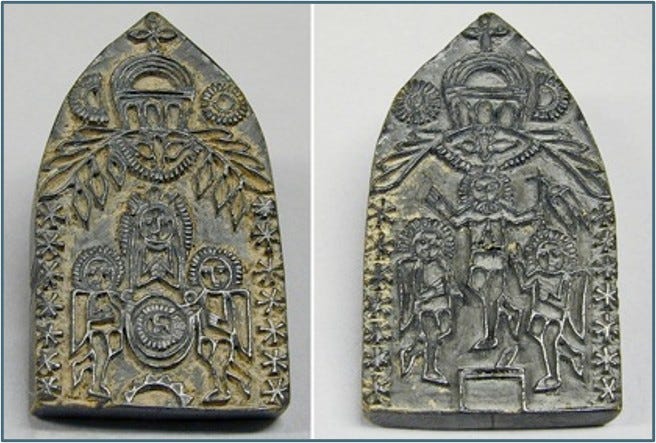
Historically, Coptic Christians, Ethiopians, and Bosnian Croats often tattooed their children with crosses, so they could later be identified as Christians if kidnapped or killed by persecutors.
It also became a way for them to express their unwavering faith in Christ, since a tattoo is, by its nature, permanent.
To be continued…
These stats were last checked/verified last summer.