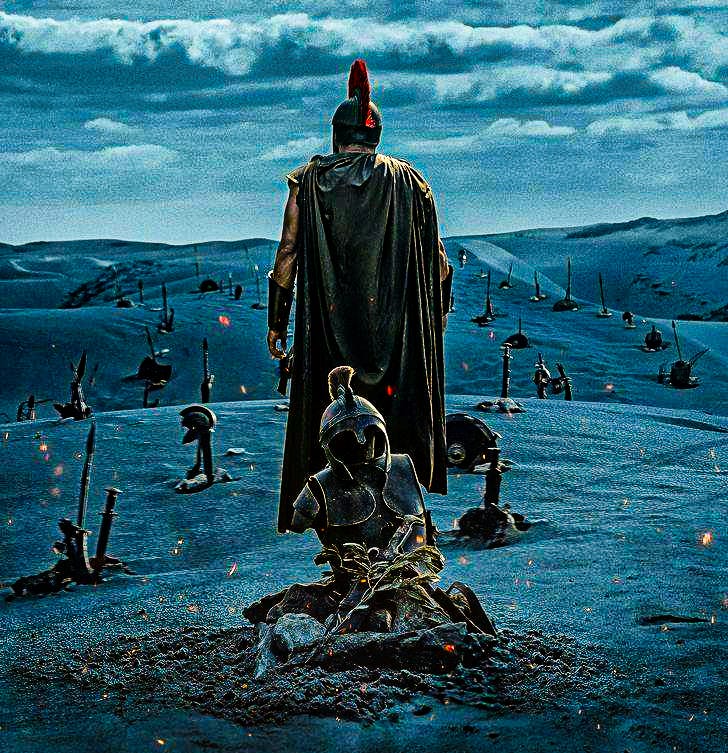
Yet all experience is an arch wherethro’
Gleams that untravell’d world whose margin fades
For ever and forever when I move.
—Alfred Tennyson, “Ulysses”

One of the trailers for the Odyssey film culminates in what appears to be an angry Odysseus (Matt Damon) chopping off the head of a statue of a goddess. This glimpse into the story follows Odysseus’ utterance: “No one could stand between me and home. Not even the gods.”
That’s not quite how the story goes. The gods stand plenty between the Trojan War hero and his homeland. While Odysseus’ bitterness towards the deathless gods is heavily portrayed, Nolan’s film shies away from casting him in open rebellion. In fact, in the film, Odysseus is merely a witness to his comrades’ desecration of the statue of Athena in the vicious exhale of finally conquering Troy.
Numerous choices in The Odyssey reveal a curious bashfulness towards the supernatural, not least of all Zendaya’s unadorned portrayal of the wise goddess of war. Nolan, well known for grounded, realistic filmmaking, blushes before deity and magic. He admits the ancient Greeks would have seen “the evidence of the supernatural” all around them, but he securely couches that vision in “lightning, thunder, earthquakes, volcanoes…the actions of the gods.”
“Why don’t the gods speak in ways we understand?” Odysseus asks.
“Who doesn’t understand thunder?” Athena says. “Fire? A child’s smile? A good harvest? Look…who’s moving those clouds?”
In Nolan’s Grecian myth, true believers and nonbelievers exist in tandem. Odysseus himself vacillates between religious duty and a mediocre hostility towards the divine disguised as fatigue over his misfortunes. He embraces Athena’s appearances but does not extend that embrace to the rest of the pantheon. Utilitarian that he is, he believes in the gods when they are in front of him—when they, like Balaam’s donkey, refuse to go unnoticed. Otherwise, he discounts his men’s warnings of omens and sacrifice when it’s inconvenient. And he basks in Eurylochus’ (Himesh Patel) praise of him as a “lucky bastard” when his implacable schemes turn out well.
By no means though is The Odyssey metaphysically stripped. The gods are pervasively present. They judge misdeeds. They cannot be thwarted. Their words do not return void. Their existence is benign, often undersold.
The plot, in fact, turns on the recognition of the divine in the stranger. Odysseus and his crew fail to recognize the strange divinity in Polyphemus and end up angering Poseidon. By contrast, Telemachus (Tom Holland) says several times of other characters, including beggars, “You have wise eyes—Athena’s eyes.” He is cautious to follow “Zeus’ Law” and abide in the spirit of xenia, even when it’s to his disadvantage. (In the film, Zeus’ law is a universal abstract: defining hospitality to strangers, rendering grace to the less fortunate, and doing unto others as one would have done unto oneself.)
Despite all this, Nolan refuses to indulge in even the most astounding and supernatural aspects of his film. While some of this is likely due to runtime constraints and the expense of filming exclusively on IMAX 70mm cameras, most of the magic in The Odyssey is left to the imagination. Some have lamented the lack of slow motion in scenes that deserve it and how quickly the camera moves on from Odysseus, in beggar’s garb, plucking his bow, sounding the note that seals the suitors’ doom.
There is no lingering here. Blink at the wrong time and you’ll miss the open mouth of Scylla. We don’t get to see into Charybdis. Apollo’s cattle are the most ordinary of beasts. The Sirens remain distant and miniature. Even the demigods, like Circe, abide in the plainest of homes.
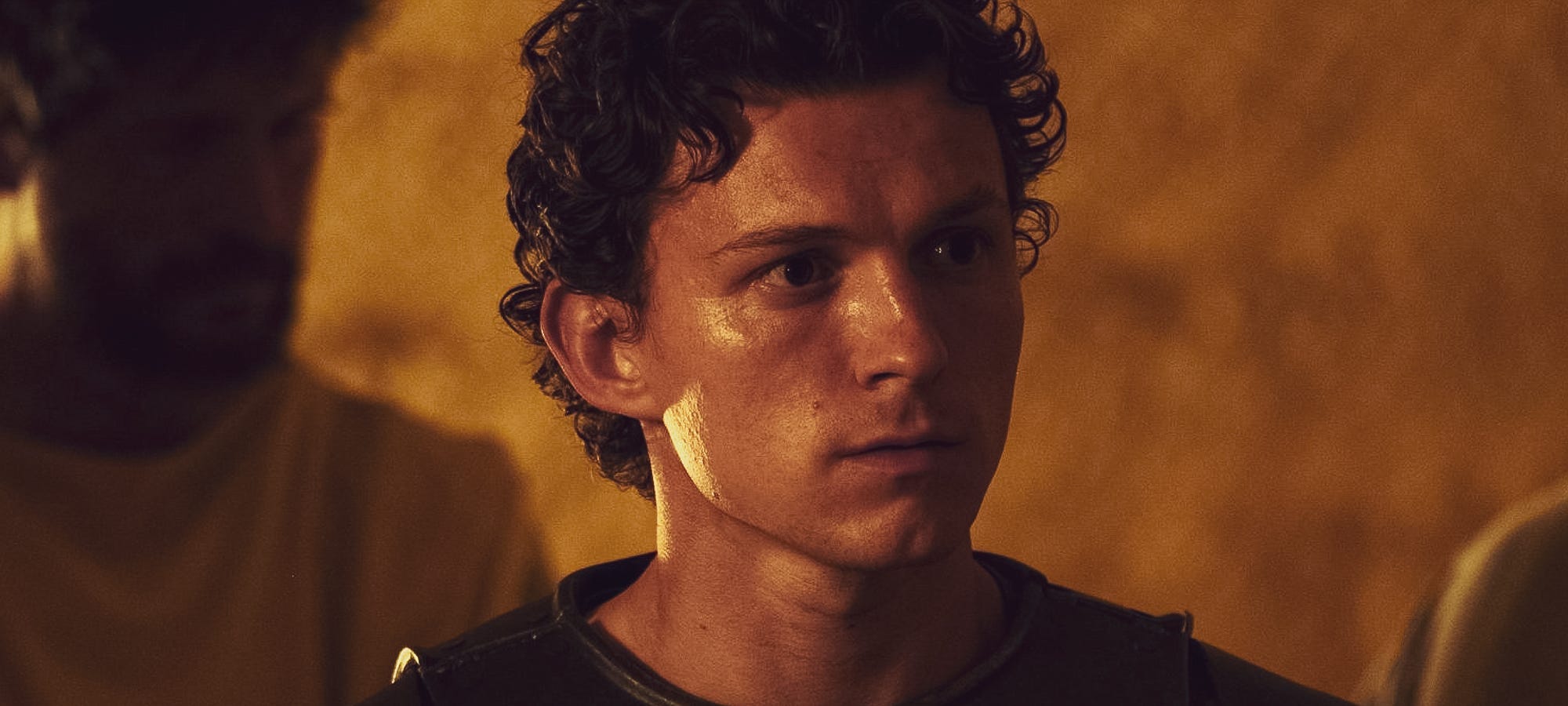
Throughout the film, Telemachus is all of us: looking for gods everywhere and being discouraged from finding them. Upon his final insistence that someone might be “Athena in disguise,” his yet unrevealed father tells him glibly, “Don’t look for gods in men…you’ll just be disappointed.”
In a recent interview, Nolan speaks of “productive ambiguity” as an important aspect of great film endings. He has spoken of it before when discussing Tenet and Inception—“the point of it is it’s an ambiguity”—making him a true postmodernist. He does not engage in discussions over what things mean, he says. But ambiguity, this sort of shyness, is all over The Odyssey, inviting the audience into a discussion of meaning.
Perhaps this is the challenge of remythologizing our experience of a civilizational text. We want magic and fantasy on our terms—in our faces, loud and undeniable. Nolan does not indulge in this desire. Jake Adkins writes:
Nolan is not explaining the gods away—he is asking what it felt like to inhabit a world in which they had not yet been explained away. He is saying that we have been so thoroughly conditioned to explanation that we have lost the capacity to feel what the ancients felt: a world in which the overwhelming is also the personal, in which nature does not merely cause but addresses. His method—the real ocean and a CGI-less set designed to achieve total immersion—is an attempt to return a modern audience to that felt experience.
The Odyssey cracks open the possibility that there might not be anything wrong with the world, but something wrong with our capacity to move in it, understand it, and extend that understanding within a social coherence. We want an undeniable voice from heaven, explaining our condition. But the Voice has never stopped speaking. Rather, as Jeremiah says, “I have spoken to you again and again; yet you have not listened” (35:14b).
We want Nolan’s camera to linger longer on the details, but he challenges us to remember what we already know, to fill in the blanks with an imagination tuned by the ancients.
One place Nolan leaves little ambiguity is in his treatment of guilt and consequences. “When your men die, do you see consequence or chance?” Athena asks Odysseus after he discovers his men defied his orders not to eat Apollo’s cattle.
“I see consequence,” Odysseus says. “And responsibility.”
That line is Odysseus’ lesson learned. The moral of his journey, if you will. The irony is that Odysseus himself pretends to defy the gods—in his pragmatic refusal to bury the dead when it’s inconvenient to do so and in his insistence that he can save his men and bring them home despite the prophecy that he cannot.

This lesson of consequence is told effectively in miniature in Agamemnon’s (Benny Safdie) story. The commander of the Achaeans seeds his own death by sacrificing his daughter for favorable winds enroute to Troy.
“The power of the sacrifice is in the cost to the person making it,” Odysseus says when recounting the event to Penelope.
“That’s monstrous,” Penelope replies.
“And committed.”
When Odysseus goes to Hades, Agamemnon is there. The slain king tells him of how his wife, grown bitter over the decade he’d been gone, kills him in bed and then wonders if one of his other children avenged him.

At every turn in this story, there is consequence. And at every turn, Odysseus is made subject to divine power. It is in his submission—in the fulfillment of the prophecy that he will return home alone—that he realizes that life is not a game of chance, that his cleverness cannot forever out thwart the strange divine council.
The war at Troy was more than a squabble over a kidnapped queen. Odysseus’ “trick,” the trick by which the war was won, was more than a pragmatist’s endgame. In Nolan’s telling, it was the monumental betrayal of a fundamental principle: the necessity of recognizing the divine (or the potential for the divine) in the stranger and in the enemy, everywhere in the world. This point is unambiguous.
“We violated all that’s ever sacred between people,” Odysseus laments. “To burn the walls of Troy was to burn the world entire… One man’s idea, one man’s trick, to break Zeus’ Law forever.”
Odysseus’ realization of consequence is what makes Nolan’s Odyssey a civilizational epic and a worthy expansion of the mythic canon. In this adaptation, the overwhelming is also the personal both for Odysseus and for us. We are spent on cocksure heroes. We are spent on incessantly traumatized protagonists. Nolan recognizes the need to make his hero’s actions, and his repentance, matter beyond his own person.
The ambiguity in this film has a purpose. The shy glances at the divine, the quick camera cut away from the mouth of Scylla, are a kind of admission of guilt. Guilt that we do not have the experience of the world that we desire—that our demythologized vision is unsatisfactory—and, further, that it is our own breaking of divine law that keeps us from a long gaze into that gleaming, untraveled world with ever-fading margins.