

“…I could wander away, wander forever, see strange and beautiful things, one after the other to the world’s end.”
In our previous discussions about whether beauty will save the world, we’ve considered: (a) that beauty is hard and difficult and must be earned, not claimed, and (b) whether we’ve lost the ability to see beauty and be drawn into it.
Here, I want to discuss what beauty is, essentially.
beauty is (mostly) truth
Recently, I read a complaint about Christians who communicate about their faith to nonbelievers with truth but not with beauty. In short, the writer claimed a crisis of individuals being self-proclaimed Jesus People while also being pricks.1
What does it mean when we say Christianity has been presented with truth, but not beauty? It means that the message has not been delivered in a manner that is consistent with itself. And that—internal consistency—is the root of beauty.2
I’ve said this before about movie adaptations of books (or any adaptation of a work of art from one medium into another): the trick is to make a thing more like itself. There is an element of the transcendental of Truth wrapped up in the transcendental of Beauty. Beauty is not beauty if it is not itself—that is, if it is not true. This is why aesthetics or following the “rules” of art cannot be the sole (or primary) measure of beauty.
That which is truly beautiful is true to itself. It is not, of necessity, wrapped up in awe or wonder or feelings of celebration, peace, joy, or any other manner of goodness. Beauty is big enough to embrace ugliness.3 We must not cuff her artificially.
A few years back, I visited Auschwitz-Birkenau, the former Nazi concentration and extermination camp. The day was cold and bleary. Snow on the ground cradled the soul-crippling, red brick buildings. Even before entering, one could feel the imprisonment.
Images of the camp, nestled in snow, are justly described as beautiful—I brought home postcards—because beauty is big enough to swallow the horrors that took place there. It must swallow the horrors. But beauty has transparent intestines. It does not dissolve the horrors that it swallows; it preserves them.
Typically, beauty is spoken of as that which deserves or provokes awe and wonder. But real beauty also provokes awe in the old Norse and Germanic senses of the word: fright, terror, anguish. In our current Western Christian contextual conversation about beauty, this gets overshadowed by the wonder, reverence, and good, proper feelings we are supposed to have when gazing at a stained-glass window or a Rembrandt or whatever.
But beauty also (sometimes) engenders terror. And it should.
Like C.S. Lewis’s description of Joy—it was always “shot through with grief.”
i am myself
“…a true work of art carries its verification within itself…” —Alexander Solzhenitsyn
In his belated Nobel Prize acceptance speech, the Russian novelist and World War II-era atheist dissident-turned-Eastern Orthodox philosopher, Aleksandr Solzhenitsyn, declared that the transcendental of Beauty might be able to do the work of both the transcendentals of Truth and Goodness. I think he was on to something—but we haven’t spoken much about goodness, and we won’t start now.
Beauty must, of necessity, encapsulate truth. It must be its own mirror, almost incapable of description without self-reference. This, says Solzhenitsyn, is “a particular feature in the very essence of beauty.” It is “completely irrefutable,” only because almost no argument outside of itself can be brought to bear on itself.
Beauty, which is itself, will survive trial.
In The Horse and His Boy, the runaway slave Shasta is traversing a treacherous mountain pass, tired and alone. It is dark. He is cold. And suddenly he realizes that someone—a Thing, a ghost—is treading alongside him. There’s nothing worse than realizing that you are not alone when you’d previously thought you were, in fact, alone.
Shasta, hesitant and afraid, dares to ask the Thing what it is.
“One who has waited long for you to speak,” says a large, deep voice.
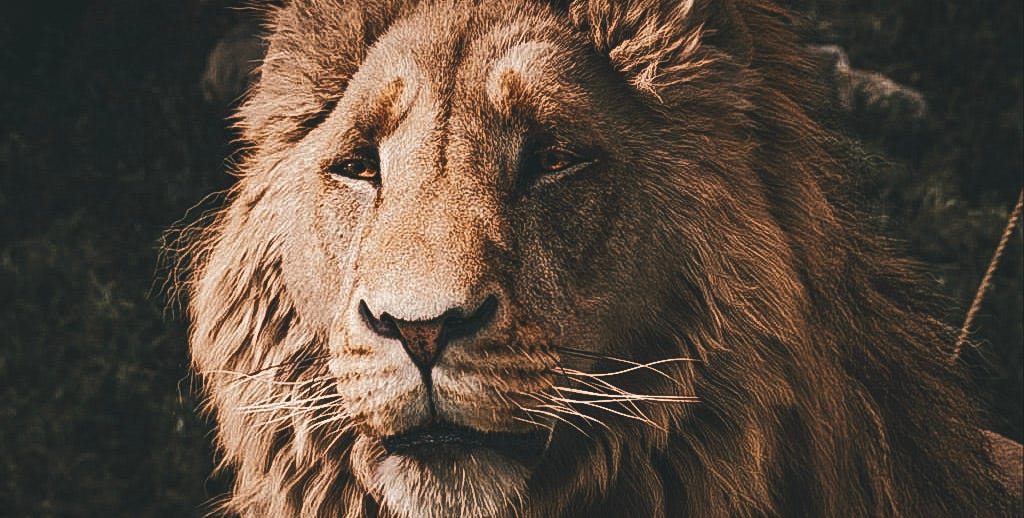
The conversation with the invisible giant continues until the Voice reveals that it is, in fact, the Lion whom Shasta had crossed paths with numerous times on his adventures leading up to this moment. The Lion had comforted him. The Lion had saved him from fiends. The Lion had wounded his friend.
“Who are you?” asked Shasta.
“Myself,” said the Voice, very deep and low so that the earth shook: and again “Myself,” loud and clear and gay: and then the third time “Myself,” whispered so softly you could hardly hear it, and yet it seemed to come from all round you as if the leaves rustled with it.
Shasta was no longer afraid that the Voice belonged to something that would eat him, nor that it was the voice of a ghost. But a new and different sort of trembling came over him. Yet he felt glad too.
That is Beauty. A thing that is truly, undeniably itself. A person who is themself and no one else. That is also Truth—that which can hardly be explained without self-reference.4 And here I will say my only bit about Goodness: it is a chaos that is internally ordered and internally consistent. It is why the Lion in Shasta’s story physically wounds Shasta’s friend for a harm that she had perpetrated on her servant. And that goodness, that justice, is beautiful.
Solzhenitsyn again:
Beauty will force its way through and soar up to that very spot, thereby fulfilling the task of all three.
You get it? But that’s entirely beside my point, which is: beauty is a thing that is fully itself.
In Joy Marie Clarkson ☀️’s interview with Ben Quash, professor of Christianity and the Arts at King’s College London, he discusses how Old Testament law called for a lamb “without blemish” to be brought for sacrifice.
Sometimes we think about beauty as something that is absolutely out of the ordinary. But, actually, in Old Testament terms, this kind of beauty is precisely being what you’re meant to be well. So, a lamb without blemish is just a really lamby lamb; not some kind of exceptional lamb different from all the other lambs, but a lamb with all the right bits in all the right places.
Beauty, as dull as it sounds, is serviceable. It fulfills the purpose for which it is made. It is a thing most like itself.
Beauty is without blemish, not because it has no errors or no areas in which it can be improved. It is without blemish because it possesses no irrelevant or substandard elements. Beauty is in the right place and rightly ordered in association with other things.
“I AM MYSELF,” the Lion says.
And he is. Nothing added. Nothing subtracted. Nothing manufactured or pretended. Nothing left to be desired.
Both the measure and the thing being measured.
Beauty is not required to stand out. Beauty is normal, not extreme, unexceptional.
All the natural things we point to as examples of high beauty—stars, flowers, mountain vistas, hummingbirds—are plentiful and unremarkable. Every time one appears, it does nothing more than any other star or flower or mountain or hummingbird. The star is very much a star, the hummingbird very much a hummingbird.
And so—they are beautiful.
This is beauty which saves the world—the ordinary lamb called to the altar for sacrifice—not because it is exceptional, but because it is perfect—perfectly itself.
Beauty is a thing as true as possible to its own nature. And a thing which is unapologetically self-referential is something to believe in.
Surprisingly, one can be snarky and sarcastic while loving Jesus. Proof: yours truly. But one shouldn’t be a prick.
It is also the root of truth.
Hence, the “poor mangled body” and “unbearable anguish” of the Passion depiction which Prince Myshkin finds beautiful in Dostoevsky’s The Idiot.
This conclusion was inevitable. It was always going to come back to C.S. Lewis. I can’t help it.
Beauty is truth. I really like this. I’ve been thinking about aspects of beauty myself.
How would the idea of beauty is truth apply to human physical beauty or ugliness?