

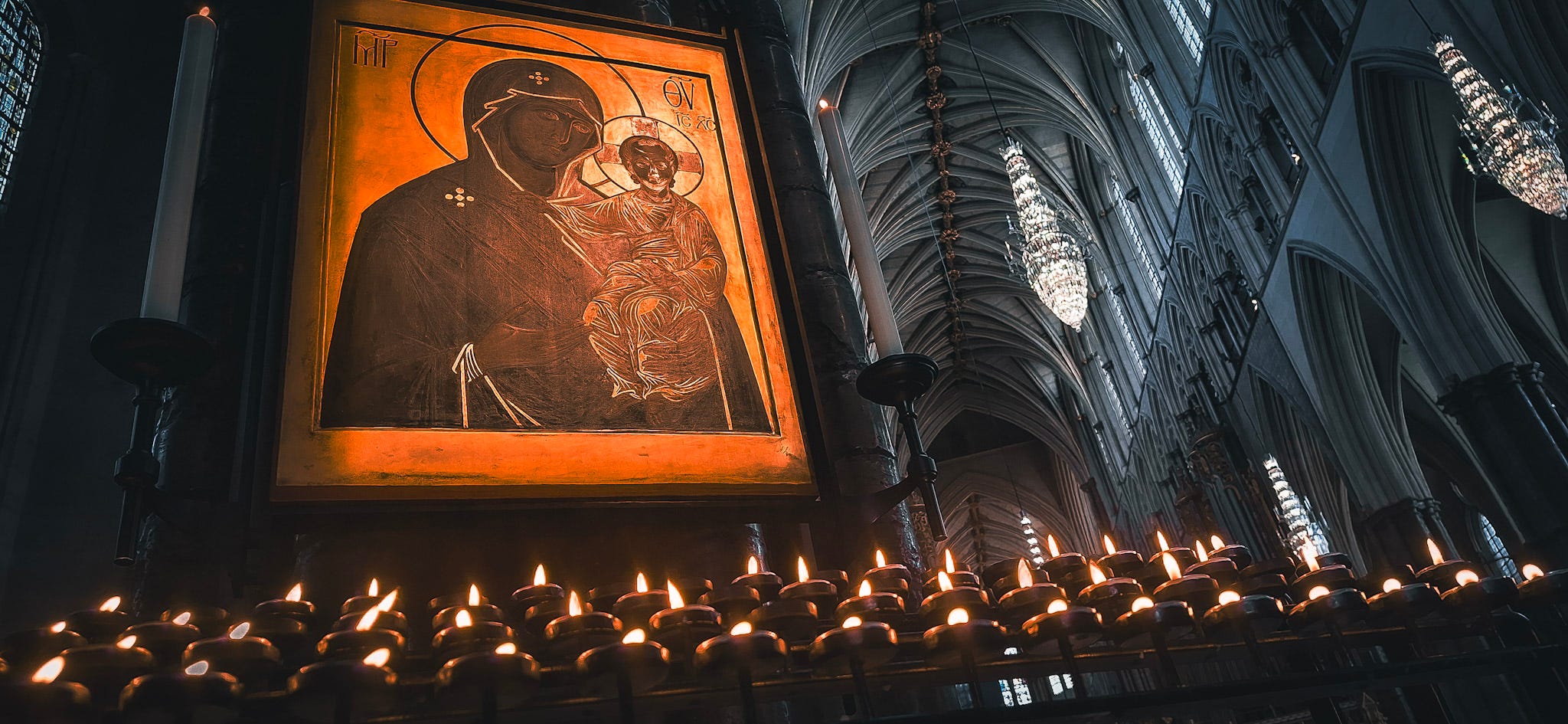
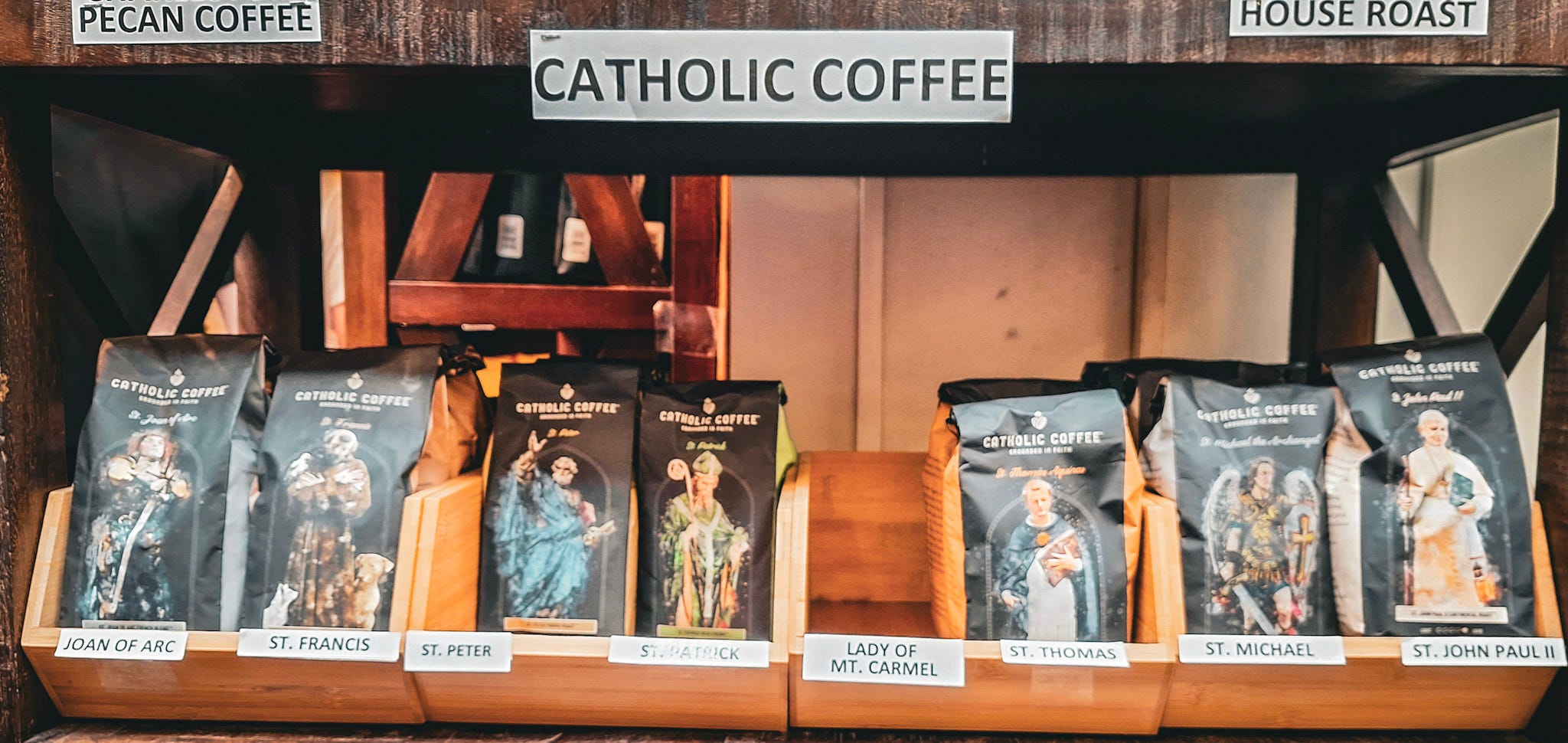
Last week, my wife and I were chatting with a friend—we were passing thru a market across from a display selling Catholic Coffee (“grounded by faith”) and LOTR coffee (“the Baggins blend”)—and something our friend said really struck me. Something along the lines of: maybe some people need ritual, liturgy, and deep religious tradition. What my mind conjured was that: maybe some people don’t need it (as much).
Think about it. According to Trevin Wax, data (and excitable anecdotes) suggest that Eastern Orthodox traditions are drawing interest and significant conversions from Protestants and the non-religious, especially among young men. Gen Z is widely reported as experiencing a “revival” that finds them seeking out traditional and liturgical forms of worship. Meanwhile, some—and I know a few personally—have traveled religious roads in Protestantism and/or American Evangelicalism and found their home in Catholic or Orthodox congregations. Likewise (according to data in Wax’s report linked above), Orthodox folks are converting to Evangelicalism at a higher rate than the other way around.
What if all of this seeking is driven by temporal need, restless dissatisfaction with the status quo, and the simple idea that one is unfulfilled where they’re at? I have wondered myself if I should not make the leap into a different mode of Christianity.
But none of these flavors—Orthodoxy, Catholicism, Protestantism—are the solo way to Jesus. Perhaps fighting over which way is more correct makes us miss the point which is whether these competing paths bring us closer to God and further into communities attempting to model heaven. Perhaps we should recognize that what works for one might not work for all, and rightfully so, as our emotional, psychological, social, and mental dispositions—and let’s face it: music preferences—all play a role in which traditions suit us and which traditions we are drawn to.
Also, the Holy Spirit. If we are all being guided, wouldn’t more of us be guided to the same place?
I read a lot this month that touched on these issues of religious homing.
Any religious person who assumes that a conversion will solve all their problems must contend with the (probable) eventual collapse of novelty and settling in of mundanity. Edwin Robinson does so in his post-conversion to Orthodoxy report, linked below. (I’d wager that satisfaction with intellectualism has a diminishing return-on-investment in any case and what we do with our bodies, in our bodies, among other bodies has the primary potential for sustained fulfillment.)

For more specifically Orthodox takes, Fr. Emmanuel Lemelson has a piece on how “convert-apologist media”—partly the aforementioned intellectualism obsession—actually divorces people from the “organic, liturgical reality of the local Church.”
Over on The Speak Life Podcast, Naomi Brehm and Thomas Thorogood discuss reasons why liturgy is making a comeback. Naomi, especially, asks some thought-provoking questions about liturgy’s proper place and whether it’s really okay to make liturgical activities so accessible that they can be conducted outside corporate church gatherings.
Speaking of casual accessiblity, Freya India has an excellent complaint on The Commodification of Christianity—because religious practices should be hard and require discipline and be different than everything else the world offers.
Get used to playing a game and reality becomes boring. How on earth am I going to get through the Book of Psalms when I’m used to iBible?
…But if you are new to faith, you haven’t developed real habits. This is a huge hurdle, trying to stick to a routine, show up every Sunday, even remember that it’s Sunday and that this is something you do now.
To close this section—and to return to my opening point that attraction to conversion may be due just as much to disposition and perceived personal need as anything else—this quote from an article I haven’t read (and this note by G. M. (Mark) Baker) sums up my general thoughts.
the devil wears prada 2
Shifting gears wildly. I intended to write a whole essay on The Devil Wears Prada 2. Five paragraphs are done—sorry, Katy. Time runs and I really need to strike this one from my plate in order to keep up with other things.
I loved the movie. It made my little writer heart happy: seeing Andy’s dreams of being a serious journalist who writes about things that matter—not fashion!—actually pan out. And then she gets called in to manage a PR crisis at her old employer, levying the acknowledgment that crisis management is all about storytelling, after all.
More importantly, Prada 2 didn’t feel heavy despite taking on some serious issues like the changing media/publishing landscape and journalism as a dying rapidly changing career form. It is a film that does the magic movies are supposed to do. Recently, plenty of media has been indulging in what is and how things are now for the sake of realism or whatever. But TDWP2 is flashy, glamorous, rich—and about people who are flashy, glamorous, and rich (and flawed in entertaining ways). It is not necessarily aspirational, but it does allow the viewer to indulge in a fantasy that lasts as long as the runtime. And that is the point of this stuff (art, movies): to make us escape, to make us want and aspire. (Not necessarily to make us want to dress like we’re going to the Met Gala every day.) That’s what’s really great about it. It’s a good escape to a fantasy world that’s still our world. It’s believable but just out of reach. We bask in the if only.

In the film, there’s a dinner that takes place under Da Vinci’s Last Supper. I planned on discussing those scenes to make some other points about art that I don’t have space for here. But I do want to share Haydin Davis’ piece which I would have quoted from in relation. She writes:
What makes this scene so compelling, especially for an art lover like me, is how seamlessly it collapses the boundaries of time. Only in a movie could a 15th-century fresco become the interpretive lens for a 21st-century character. A Renaissance meditation on betrayal can become a commentary on human nature and professional ambition in the workplace.

what else?
»» Mere Orthodoxy launched a new member interface, and Jake Meador offered up this excellent articulation—the best I’ve read in recent memory—of the current media and cultural landscape and what Christian creative outfits should be aiming for within it.
»» sustaining creative aliveness while working a full time job — This was a good reminder that one’s “day job” is not necessarily the enemy of the creative life. I appreciated what Nix terms the “profound, gorgeous, emptiness” of some of the places where I’ve done my best writing—“plane rides and hotel bars,” liminal spaces where time can be stolen back from the daily routine. Read thru the end for some fun and helpful tips on keeping a creative practice.
»» This essay is not for people sensitive about language. But Mike Birnigglia’s satirical take on what some deem a controversial slang term is actually a brilliant demonstration of the elasticity of our vocabulary.
»» Susannah Black Roberts writes about scrupulosity, biblicism, nouthetic counseling, and St. Paul in the Areopagus. She demonstrates the common, bright lines between ancient philosophers and Biblical personalities. (We simply must stop pretending that anything beyond a plain text reading of our favorite translation is anti-God.) She also discusses a helpful framework for dealing with anxiety.
»» I loved Andy Squyres’ homily, you don’t need a miracle, you need a job, because sometimes you do just have to get up and do the thing.
»» The Monotony of a Childless Marriage — Being wed now for less than a year, marriage is the furthest thing from monotonous. Still, I appreciated Lore Wilbert’s experienced and sober take on the parts of life that become routine and how to find the “magic” anyway.
»» These days, no movie can be made without controversy it seems and John Byron Kuhner explains why some recent conversations around Christopher Nolan’s Odyssey seem weightier than usual — Post-Literacy Raised the Stakes of the Odyssey Debate
»» Prof. Brenton Dickieson’s book, The Spiritual Imagination of C.S. Lewis, is out in a month. The nerves might be getting to him as his latest essay is on social media trolls, the state of book criticism, and how Lewis can help us think about “the problem of judging a book by its author instead of its argument.”
asides + signal boosts
📖 Reading
Undaunted Joy: The Revolutionary Act of Cultivating Delight by Shemaiah Gonzalez. This book is instructional by example, a collection of short essays rooted in life experiences that make it easy to see how joy can be found in the ups and downs. (Fun fact: I don’t know how I first started following Shemaiah’s work, but we had the pleasure of meeting in London back in 2023 when, if I remember correctly, she was writing this book.)
🎞️ Watching
We’ve been watching House of David (8/10 despite bizarre plot choices) and started Spider Noir (fun, at least the parts I’ve seen before falling asleep).
🎧 Listening
The Dune 2 soundtrack has become a late favorite go-to for writing.
Stumbled across The New Yorker’s Critics at Large podcast this month and have listened to several episodes on the Met Gala, romantasy, earnestness, and our modern glut of choice.
Enjoy summer!
thanks for including me! 🥹 i loved the movie and knew i wanted to write something about the painting coming up on screen. so interesting to see how my substack audience generally agrees with my take, but my tiktok comments are savage to say the least. lots of people saying it was “disrespectful to christianity” etc. which i felt like was a super narrow read of the scene! there’s alot more to it!
Thank you for sharing my book! I am so glad we met and hope the next visit isn't too far off.