

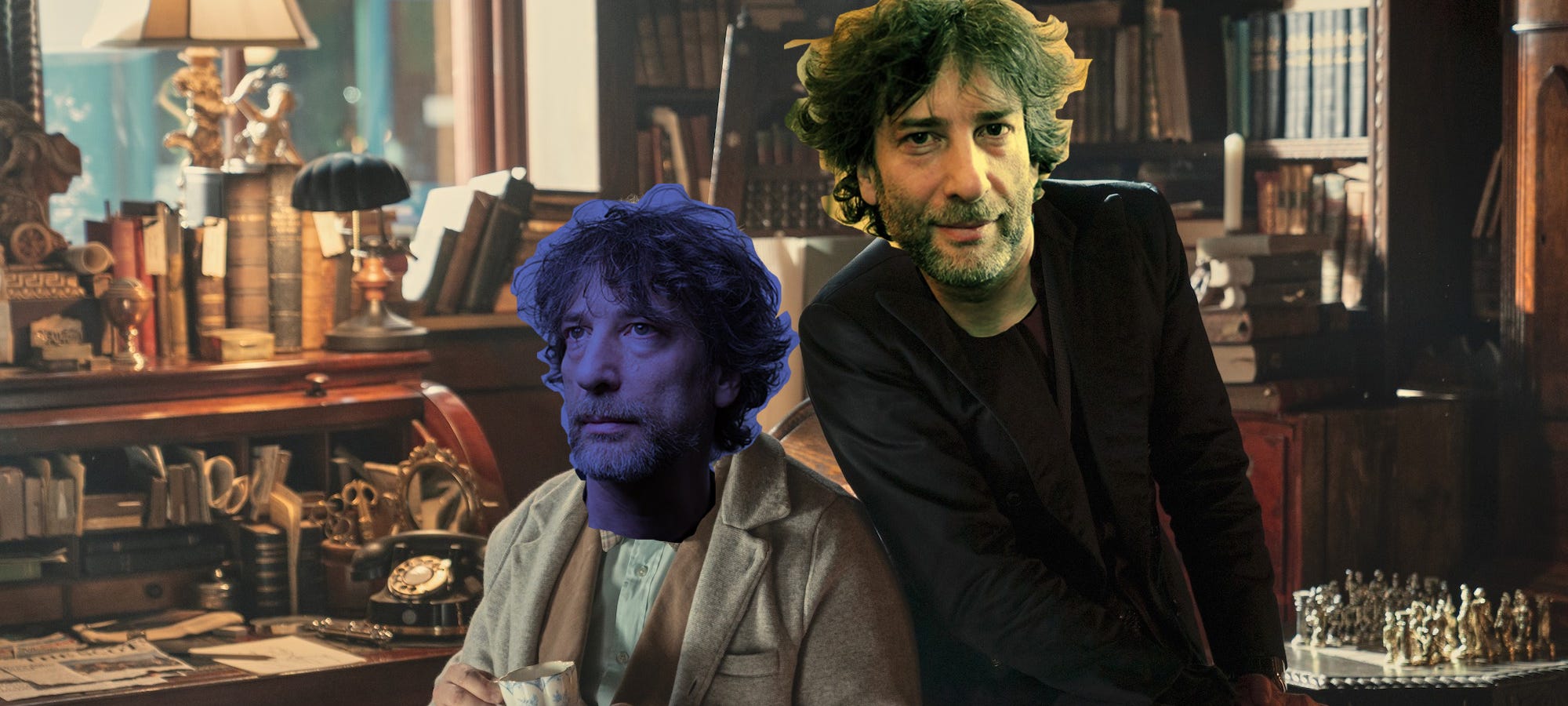
Sometimes, life imitates art. Other times, art imitates theories of literary criticism.
This is what happened with the third and final “season” of Good Omens, the BBC/Amazon-produced follow-on to Neil Gaiman and Terry Pratchett’s hilarious, irreverent speculative fiction (1990) about an angel and a demon trying their darndest to preserve the world for the sake of its creature comforts.
After the widely-praised and “exceptionally book accurate” TV adaptation of the novel (2019), Gaiman pioneered a completely original second season (2023) intended to serve as connective tissue between the novel and its sequel which he and Pratchett started brainstorming in 1989. Says Gaiman:
[we] plotted more of it in New York in 2006…and then talked more about it from time to time until Terry’s death... So I know what happens, sometimes in detail, sometimes in broad strokes, and I know the last ten minutes of it to the beat.
The planned six-episode third season (2026) would have been based on that brainstorming. But production halted in September 2024 after several women accused Gaiman of sexual assault and gross misbehavior. (Production also stopped on an adaptation of The Graveyard Book.) A month later, Gaiman offered to end his involvement with production of the final season—as if that would make things better for either himself or the show. Shortly thereafter, not only were Gaiman and his company cut from the production effort, but it was announced that the six-episode season would be reduced to a single 90-minute finale episode, out last month.
We won’t get into a whole can we enjoy art from misbehaving artists thing here. (I’ve written about that already.)

Likewise, I have not done a personal deep dive into the allegations or conducted a large-scale analysis of my current feeling towards Gaiman, one of my favorite writers. There is this immovable constraint—time—which makes such a pursuit unappealing. (Also, I am trending towards holding all immensely talented people in a category of indifference based solely on the history of the past two decades.1) Gaiman’s alleged behavior—of which I’d wager at least some is true—is abhorrent and reprehensible, especially as perpetrated against fans and those on the low end of inequal power dynamics. If you wish, you may find the popular (salacious) interpretation of the allegations with a quick internet search.
Gaiman, for his part, remained silent publicly until February of this year when he posted a message on Instagram, thanking his supporters, declaring that the allegations are “completely and simply untrue,” and linking to the investigative journalism of one who goes by TechnoPathology here on Substack.
Here, I intend to spoil the 90-minute finale and discuss parallels between the Good Omens storyworld, what happened with Gaiman during the production of the finale, and the whole “death of the author” question. The parallels and opportunity for conversation are curious to me, and I’d be remiss if they continued unobserved.
the problem of everything
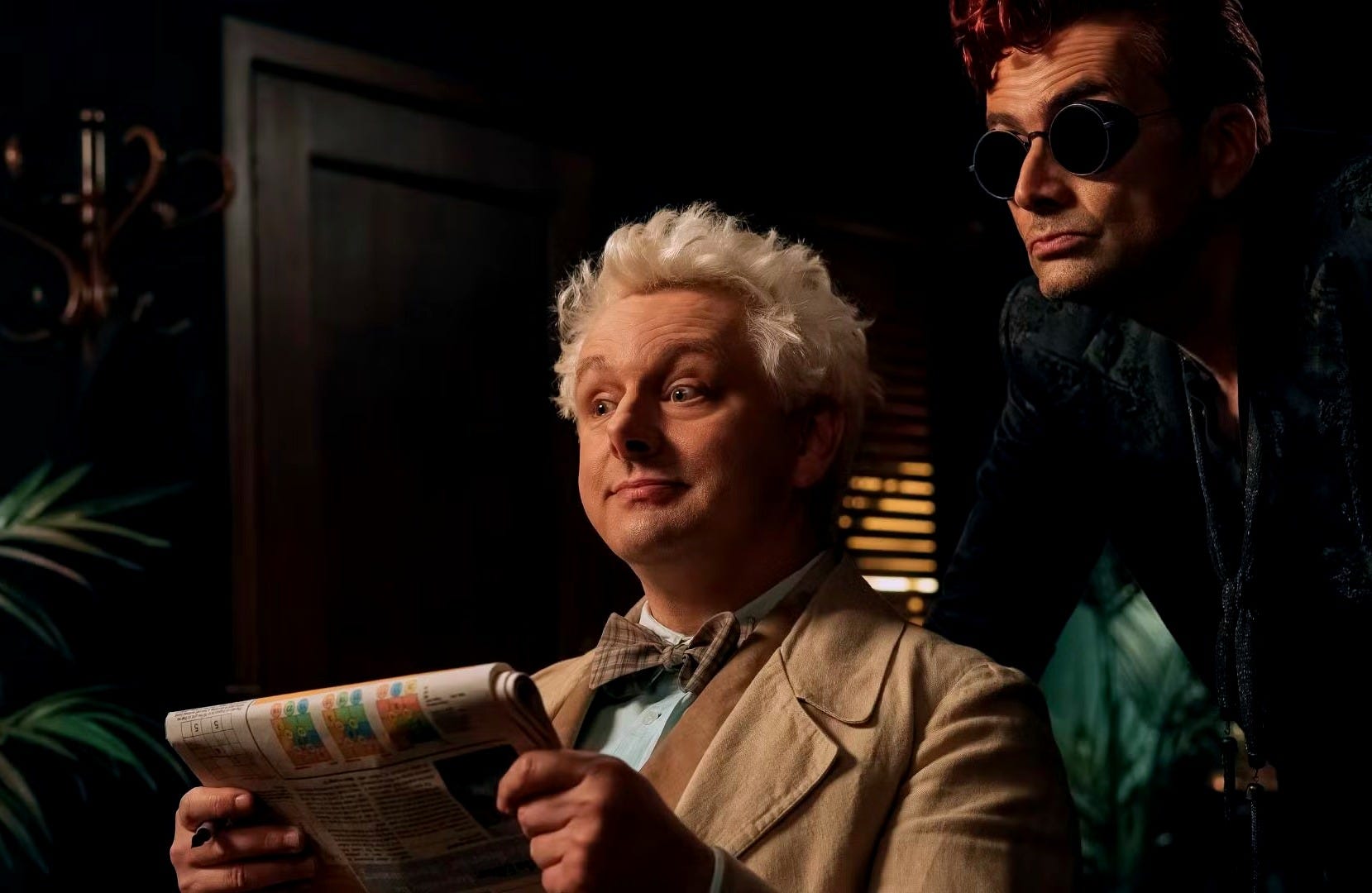
The finale opens with the angel Aziraphale (Michael Sheen) in a high management position in Heaven. He pulls together a small team and announces that it’s time to begin Operation Second Coming—but not as another attempt at “Armageddon.” Instead, he wants to set things up as “a second chance to get things right… to make things better. To inspire the humans, to be…you know, nicer.” He’s even reawakened Jesus—humorously and beautifully played by Bilal Hasna in one of the better parts of the episode.
Of course, this not so ineffable plan doesn’t go accordingly. It soon becomes apparent that Jesus, the Book of Life, and the Metatron (the highest being in angelic management) have gone missing.
Attempting to avert a cosmic crisis, Aziraphale descends to Earth in search of his old demon friend Crowley (David Tennant), whom he hasn’t spoken to in a long time. The two had a falling out at the end of Season 2 after Aziraphale took up the management position in Heaven instead of eloping with Crowley and living on Earth.
To make (what should have been) a long story short, Aziraphale and Crowley figure out that Michael has stolen the Book of Life and is now using it to destroy the world. They rescue one sliver of the universe—Aziraphale’s old bookshop in London—and take shelter there. Satan shows up, naturally. And eventually, Aziraphale summons God so he and Crowley can ask some questions, as one does at the end of time.
God (played primly by Tanya Moodie) is seemingly unmoved by the destruction of almost all her universe. (Perhaps it is an ineffable plan after all!) She humors the last three remaining creatures, fielding their queries about what Crowley terms “the problem of everything”: Why was it a good idea to make fallible humans, deposit them in a world geared for hostility and spite, and punish them for their inevitable wrongdoing? Why create an infinite universe, run it for 6,000 years, and then decide to end it?
Most importantly: what to do about it now?
God surprises Aziraphale and Crowley (and Satan) by offering the angels the chance to determine what happens next to the world as they know it.
“We want you to create another universe,” says Aziraphale.
“One without angels. Or demons. No god. No satan,” Crowley continues. “A universe without a heaven and without a hell.”
“No great plan, nothing ineffable. It just starts with a big bang and ends billions of years later, with the heat death of the universe.”
God is bemused. “You’re asking God to create a godless universe?”
the death of the author
This concept of a god-created universe without god made me ponder the irony of a Gaiman/Pratchett-created universe without either of them. The real cross-nail is Amazon/BBC cutting Gaiman & Co. from a production so dependent on Gaiman for its very existence in the first place.
Back of all that lurks Roland Barthes’ idea of the death of the author and the liberation of texts from the identity of their writers. (Which, now that I think of it, is a neat solution to the question: what do we do about the art of artists who behave badly? But this is not that essay.)
“The image of literature to be found in contemporary culture is tyrannically centered on the author, his person, his history, his tastes, his passions,” the French critic-philosopher Barthes wrote in 1967. Despite his displeasure, it appears we have maintained, both as readers and as critics, the perspective he so despised. In fact, in our oversaturated, social media-suffused society, the importance of the author-creator’s identity has achieved hyperstatus. The author-creator cannot escape the tyrannical audience hell-bent on holding the creator at risk for every social or political opinion, every ethnic or economic affiliation, every indiscretion or vice. Look at J.K. Rowling. Look at Amélie Wen Zhao. Look at films and filmmakers as points of political arbitration. Look at everything, everywhere, apparently.
Contrary to Barthes’ desire—and contrary to those who vehemently dislike the “death of the author” discourse—the importance of the author’s identity has increased exponentially. Attempts to erase an author from their work incur the work becoming further shadowed by the author. And so, Neil Gaiman is removed from Good Omens Season 3, but we cannot think about it without thinking about him. The god-made world is without a god and we wonder where he might be and how the world might have proceeded differently if he had been around to rule it.
I am not sure if the ending we have for GOS3 is anything like the “last ten minutes” Gaiman would have delivered should things have gone according to plan. (Even Satan is like, “You aren’t going to indulge them in this nonsense, are you?”)
In the ending we do have, God allows Aziraphale and Crowley’s request.
“I’ll make it. I’ll make the universe your way. I’ll even let an Earth happen. Eventually, there’ll be humans and life, in all of its mundane glory. Something that both of you will neither know or experience, though.”
According to TV-making rules, it was so.
Presumably, there was no god to declare that it was good.
who calls it good?
For Barthes, this idea—that “the explanation of the work [must always be] sought in the man who has produced it”—had exceeded its expiration date. Nor did the role of explaining the work belong to the critic. It belonged to the reader.
…the reader is the very space in which are inscribed, without any being lost, all the citations a writing consists of; the unity of a text is not in its origin, it is in its destination…
In his later writing, Barthes’ insistence on a “multi-dimensional space” for the interpretation of a text makes sense. But that space, in my opinion, exists between the creator and the audience. It is not a weight carried solely by the audience over against an impoverished and diluted creator.
Here I, a reader, exercise my right to disentangle Barthes’ work. He claims:
…the reader is a man without history, without biography, without psychology; he is only that someone who holds gathered into a single field all the paths of which the text is constituted.
But can that really be true? Without the author-creator, we have none of the above. No history, biography, psychology, sociology, religion, economics. Any of it. Without the author, the reader’s place as interpreter and disentangler is meaningless. Without a past—without a voice telling us the story of ourselves—we have no future that matters and no criticism that is anything other than absurd.
Cracks show quickly in those systems which value the reader’s interpretation of a text over all other interpretive frameworks. Recently, Selen Ozturk opined on the expansive BookTok trend in which “verklempt” readers ventilate over how much a book matched their own feelings, identity, and mental state as a means of citing that book’s value to other readers. Often, points are given for mere representation, by which is meant an accurate and unchallenging portrayal of one’s pet population subset. Dozens, perhaps hundreds, of books have achieved bestseller status thanks to these fecund reels. Such reels are not criticism by any stretch of the word—they do not even count as reviews; but they are the logical end for a world in which audience self-perception is pedestalized.
Ozturk writes:
This critical foundation [that the reader’s identification with the text is all-important], personal though it seems, presupposes a reader equally knowable across anyone who can read at all…
The author becomes the provider of a service (the book) serving the emotional needs of the reader (who the protagonist reflects if the book is good). The stronger the reader’s therapeutic identification with the protagonist, the more recommendable the book. The wider the distance between the reader’s and protagonist’s desires or sense of what is deserved, the less recommendable the book.
Clearly, one reader or a segment of readers cannot dominate the interpretive and applicable perspective of all other readers. This type of environment, in which the audience reflects itself back to itself—pointlessly, ceaselessly—impoverishes and depletes the multi-dimensional interpretive space. It is also most at odds with the author-creator’s contribution to that interpretive space. It is like trying to excuse a chef from her kitchen.
The author is always either attempting, like God, to express an infinite self or to make sense of an infinite world. He is casting the net into an inchoate sea and offering his catch up to an audience. The audience’s role is to eat, and then offer a range of responses from digesting to vomiting.
Barthes’ claim that the author “no longer contains within himself passions, humors, sentiments, [or] impressions” is a false dream. If the author had none of these, the reader would have nothing to contend with. A text “eternally written here and now” is a fallacy.
There is no point, as Ozturk writes, in “denying the reader the consolation of being ‘written’ by the author.” Art shapes because it has been shaped. And “art which leaves a person’s inwardness completely secure” (to borrow Kierkegaard’s words) is false.

There is no reader, no audience, without a creator. No world without an author. And like the ultimate Creation narrative, the story is neither God’s nor man’s alone. Granted, the author is simultaneously, uncontrollably, “written” by his audience. This fact has discovered Neil Gaiman.
The author may be hidden, but he is never dead. Even the new, supposedly godless world at the end of Good Omens contains “13-billion-year-old” traces of providence. Aziraphale and Crowley, reunited, gaze at the stars and see through a glass darkly. One day, they will stand like men and see face-to-face.
As will Gaiman. His stories, whether they all make their way out of his head, are his own but his story is not. His is reliant on his readers and fans. To them he writes: “Thank you…for your belief in my innocence and your support for my work.”
And he concludes: “It has meant the world to me.”
OF INTEREST

And the past 6,000 years if we take Good Omens’ worldview seriously.
Yes, that kind of thinking is part and parcel with the mindset that writers can only tell about their own experiences.
Perhaps Barthes flew to close to the sun of a shiny, interesting idea that shouldn't have gone as far as it did. Or maybe he was just predicting our future.
One of the most morbid things about this entire case has been the way former fans, reporters and claimants themselves have appropriated Gaiman’s own works, interpreting them as confessions, such as when Richard Madoc in The Sandman says ‘‘you know I consider myself a feminist writer’’ while he gets his talent from the literal violation a muse trapped in the attic.
This was considered Gaiman’s most perceptively feminist work, and his own resemblance to Richard Madoc was considered as showing a level of admirable self-awareness, self-deprecation - his recognition that the darkness was to be looked for within rather than projecting it onto external villains.
In the ransacking following the allegations this sort of narrative hijacking felt deeply wrong. It strayed far into the subjective realm at a point where the facts of the case were not established with any degree of certainty, and in fact most official procedure appeared more exonerating than not. But it also seemed to weaponise the readers right to interpret in ways that undermined the creator’s right to create, and I’m given to wonder if writers will now be cautious about writing any sort of flawed partial self-insert lest they have their works turned against them in this way.
If any interpretation is valid, and the author’s intention is written out of existence, it just seems like an excuse to turn art into propaganda, like blaring ‘‘Born In The USA’’ at a Trump Rally despite it being a decisively anti-authoritarian critique of the Vietnam war and the treatment of veterans.
I’ve never loved Barthes. I’ve never understood where his logic lay, except perhaps as rationalisation of jealousy, as the authority of the author is obviously to detriment of that of the critic-academic.