

“What I didn’t want is for you to feel that you were watching a classic interpreted with reverence, but with urgency—and something alive now.”
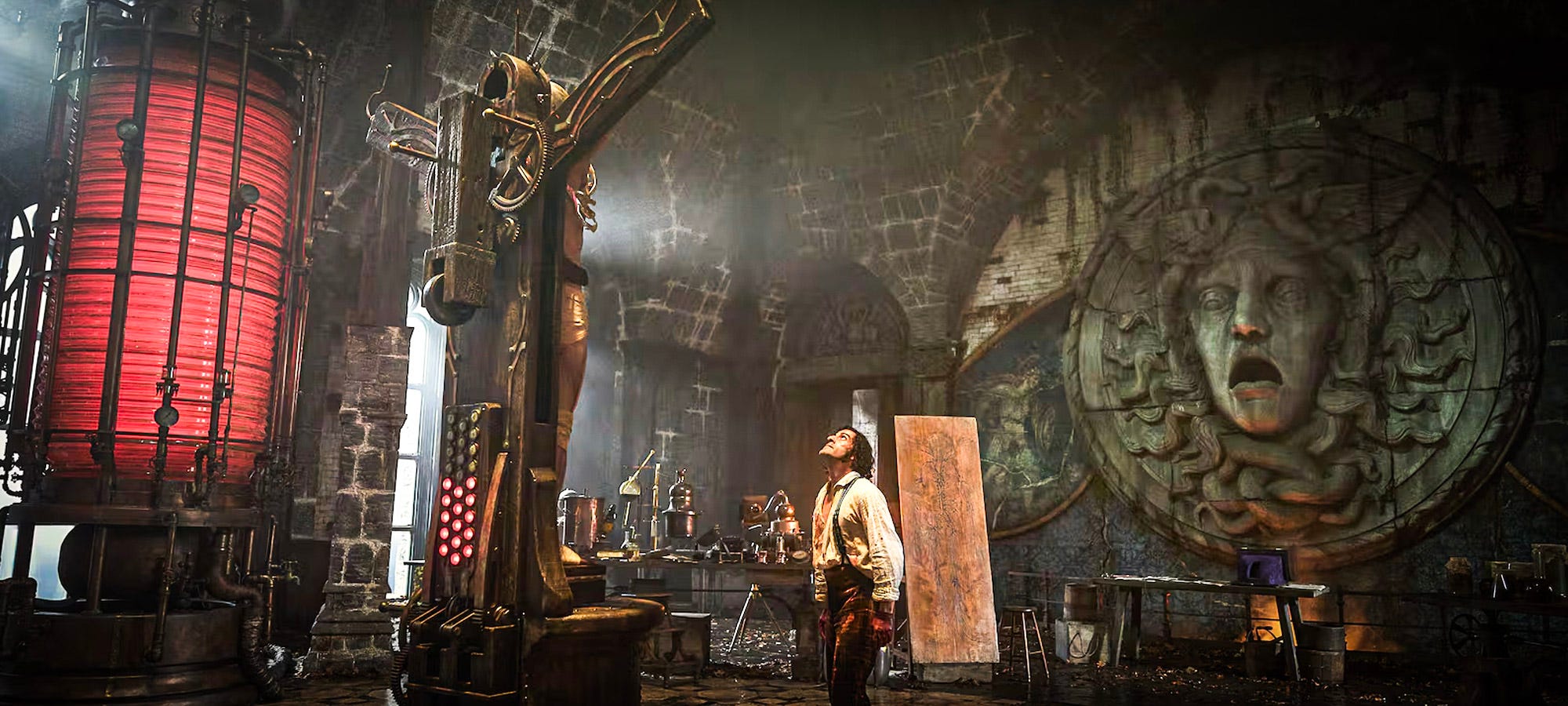
Watching Guillermo del Toro’s Frankenstein, I couldn’t stop thinking about artificial intelligence. AI is the creature of today’s mad techno-creators. GDT’s film—a beautiful work and substantial adaptation of Mary Shelley’s novel—whispers about this in a number of ways.
But, first, some thoughts on the adaptation itself. It’s been two or three years since I’ve read Frankenstein; or, the Modern Prometheus, and it took me a bit to recognize that Guillermo del Toro makes significant narrative departures from Shelley’s work—not that any other Frankenstein adaptations follow it so precisely either.
[SPOILERS FOLLOW]what’s essential to its being
Instead of being alive for most of the story, Victor’s father is excused from the narrative early on, his harshness and hinted-at role in the death of Victor’s beloved mother (played by Mia Goth) becoming the spark that ignites in a young Victor the passion to conquer death. Elizabeth (also played by Mia Goth!) is Victor’s love interest and eventual wife in the novel; in GDT’s telling, she becomes the fiancée of Victor’s younger brother William (Felix Kammerer). Victor (sturdily and impassionately portrayed by Oscar Isaac) is teased as a foil to William and Elizabeth’s relationship,1 while Elizabeth becomes a foil to the standard depiction of the Creature (a soulful, miraculous2 turn by Jacob Elordi).
These are notable structural departures (and there are others); I point them out to say that this Frankenstein remains a powerful adaptation and proof of the sustained mythic elasticity of Shelley’s original gothic horror. It’s also proof that old things made “alive now”—to use GDT’s words—are not always bad. His Frankenstein feels original; his creature, which took him 30 years to bring forth, is full, powerful, determinative, and measured. It’s beautiful to look at, beautifully scored, and beautifully written.
On adaptation, del Toro says:
The goal isn’t to sing the same song; it’s to sing it with my own voice…
To be faithful to the book, I believe you have to be as biographical as Mary Shelley was.
To that end, del Toro’s changes to the script are driven by the similarities he sees between his life and Shelley’s, as well as their differences. “The changes I made are numerous,” he admits, “but always in service of this film.” His particular Frakentale rings true because it is rooted in specificity of time, place, and belief systems—both his, Shelley’s, and the audience’s. As a not insignificant example, the famously lapsed Catholic admits:
The pageantry of Catholicism is very present in my work…that’s one of the biggest differences between me and Mary Shelley. She was a Protestant girl from England. I’m a Catholic boy from Mexico. Big difference in temperament.
This Frankenstein is different, but it is also the same—in the way that every childbirth is different but also isn’t. GDT captures what’s essential to Frankenstein’s being.
ardour that far exceeds moderation
Now, back to what I think this particular story speaks to in our time, since it is a story of our time. AI is only one manifestation of that broad, questionable creative impulse with which Frankenstein converses. The story speaks to the creation of monstrosities that will, eventually, span beyond our reasonable control—autonomous weaponry, automated policing, designer babies, and social media’s algorithmic refinement, which forces us into narrower and narrower modes of thinking and being.
Frankenstein is about fatalism, acceptance, and inevitability. It’s about the creation of machinations capable of our own unmaking and how we will (or won’t) live with them.
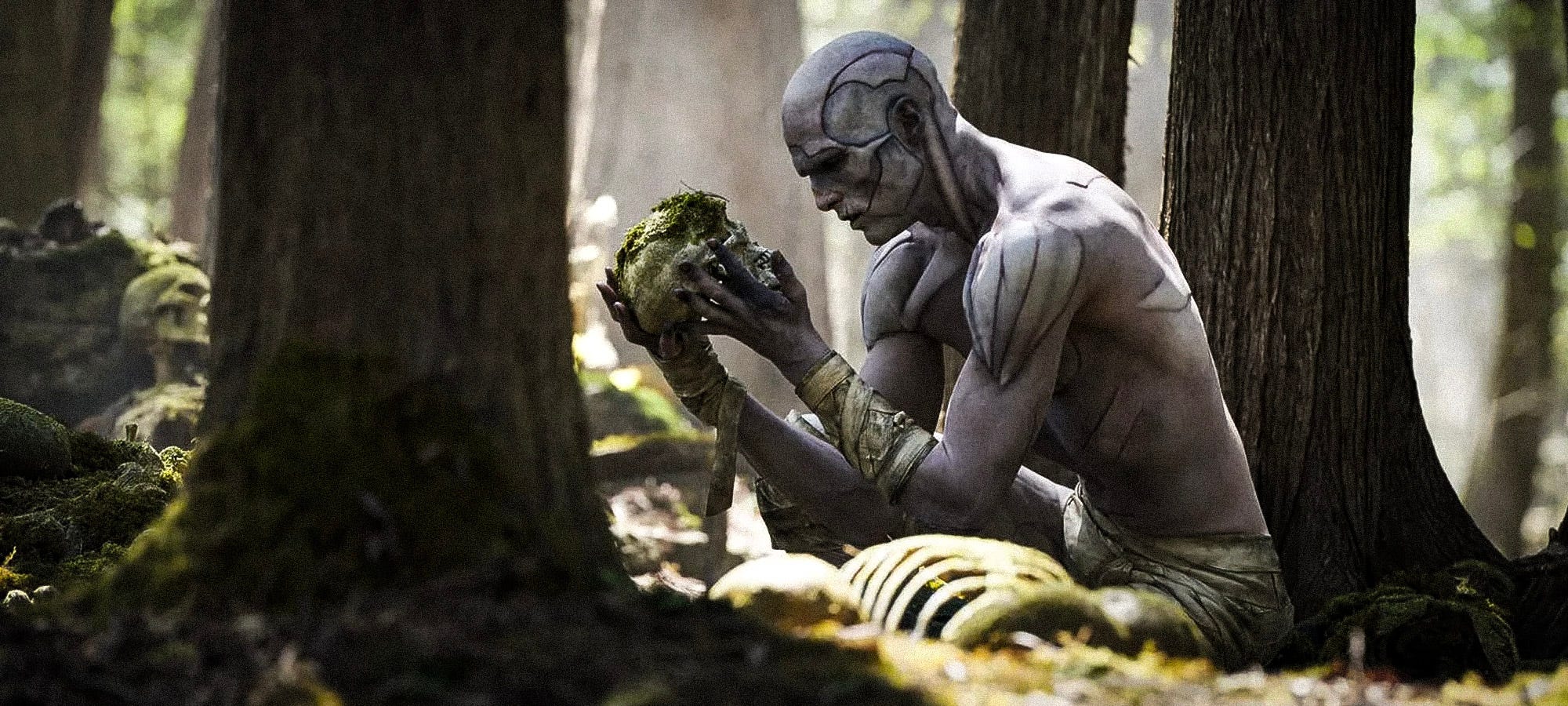
A critical difference between Shelley’s Creature and del Toro’s is that del Toro’s is self-healing. He is shot and stabbed multiple times and blown up twice, but he is essentially a perpetual motion machine—unkillable, unstoppable once animated—making artificial intelligence and advanced robotics an easy-to-grasp case for analysis.
What we do about AI is morally significant. Frankenstein’s visual grandeur, especially Victor’s lab (located in a solitary but magnificent gothic tower), maps onto the modern birthing womb of artificial intelligence: big budgets, ambitious promises, risky ethical terrain, huge leaps in capability unleashed on the world without any unified system of accountability. To borrow from Shelley: “with profane fingers,” techno-creators have already bestowed “the tremendous secrets of the human frame”3 onto thousands of amoral mainframes.
Elon Musk is aiming to raise $20 billion to invest in AI. He admits to Peter Diamandis (who has written a book on how to “reverse aging” and “not die”):
When we ultimately create a digital superintelligence that can enable [the] future of abundance there is also some chance that a digital superintelligence could end humanity…
In a way, this is what happens to Victor. His own end is the end of his pursuit to create life and relieve the bounds of death.
What is the motivation for the pursuit of artificial superintelligence—or anything that pushes the nature of humanity beyond its perceived limits? Ambition? Mastery? Ego? Whatever the case, like Victor, we rush headlong into creation, enflamed by the novelty of breakthrough and disruption, aiming for dominance in something that we do not fully understand, desiring with an ardor that far exceeds moderation.
As for del Toro, he told Reuters: “Artificial intelligence I’m not afraid of. I’m afraid of natural stupidity, which is much more abundant.”
unable to endure
In Shelley’s telling, when Victor beholds his Creature, he runs. “Unable to endure the aspect of the being I had created, I rushed out of the room.”4
Del Toro, however, has Victor first try to teach and nurture his Creature, though it soon becomes clear that the Creature has a mind of his own. (Or its own, as Victor insists.) Victor becomes angry, violent, and hopeless. He realizes his mistake and tries to destroy the Creature. This, of course, does not work.
The Creature pursues Victor. Victor pursues the Creature. Both are in a terrible dance of attempted destruction.
Is this our future? Will man replicate God’s creative act but be incapable of replicating divine responsibility?
Accursed creator! Why did you form a monster so hideous that even you turned from me in disgust?
In the world GDT creates, it seems mankind is incapable of beholding the monstrosities made with his own hands. Man runs either from his monsters or with his monsters. We cannot truly face them. Our impulse is to become one with our creations or attempt to destroy them. We are limited by our humanity: our emotions, relationships, lineage, and context. Life and death are to us “ideal bounds,” which perhaps we should not break through. But this realization comes too late.
God, on the other hand, is capable of beholding the monstrousness of his creation. He does not run from (or with) his monsters. He faces them and their offspring. He can do so because he cannot create beyond himself. He is unlimited, infinite, and so can sacrifice, redeem, forgive.
This is where del Toro ultimately makes his mark on Shelley’s story.
For Shelley, both Victor and the Creature are irredeemable, incapable of reconciliation. They pursue each other to the bitter end. Victor dies lamenting his inability to end his Creation, perhaps a prediction of mankind’s ultimate conflagrations with its alienic inventions. “The task of his destruction was mine, but I have failed,” Victor says.5
As he observes his creator’s corpse, the Creature laments how evil became his good, how the light he’d gained through knowledge and observation of kind humans became useless to him. He tells his onlooker, “Your abhorrence cannot equal that with which I regard myself,”6 and commits himself to destruction.
Del Toro does not find this resolution appealing. “Mary is really brutal with the Creature,” he says. “If you read the novel, the Creature is really demonic at times—and, still, you love him.”
Del Toro capitalizes on that love and pushes his film’s ending toward transcendence. With his Creature existing entirely outside of his creator’s control and incapable of being destroyed by human means, the stakes are more significant. Simple destruction is not the answer. Divine capability enters the scene.
That earlier quote where GDT says natural stupidity is more abundant than artificial intelligence is incomplete. He follows up with: “We live in a time of terror and intimidation, certainly. And the answer, which art is part of, is love.” His film is faithful to this belief.
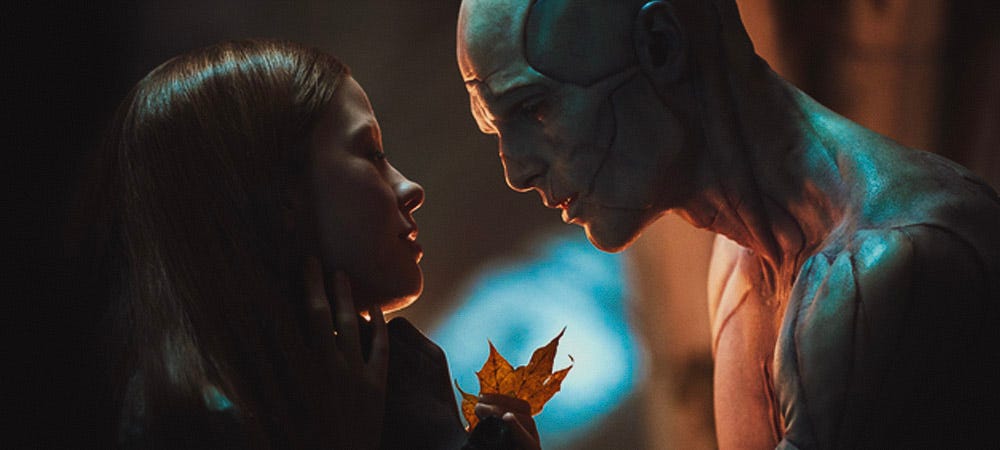
In del Toro’s ending, the Creature, who cannot be punished beyond mental torment and will not be absolved, offers his creator forgiveness for his parental wrongs. Victor accepts the responsibility that he is incapable of actually exercising, claiming the Creature no longer as “it” but as “son.”
The drive to this ending is what fills GDT’s Frankenstein with “urgency” and “something alive now.” It calls the viewer to become capable of beholding the monstrosities of our time, genuinely facing them and accepting the divine weight of responsibility.
We must consider that the monstrosities of our children’s time may well include creatures very similar to Victor’s. We must learn, as does Victor, to behold them and to wrestle with them in the way that divinity wrestles with monstrous humanity and ends up designating some as sons.
“For me, what we strive for with art is grace,” del Toro says. “If we can achieve grace at the end of the movie, and emotion with it, I’m in.”
He laughs. “It seems like I’m still Catholic.”
asides + signal boosts
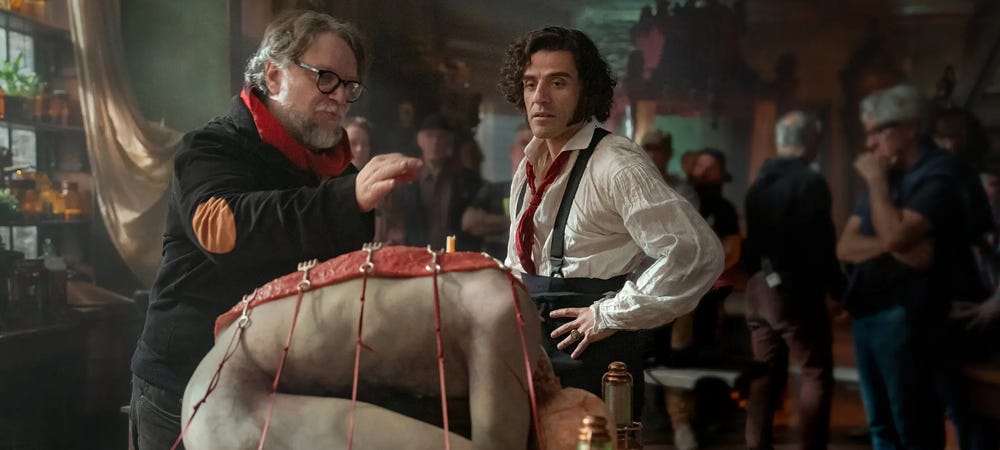
Listening to Guillermo del Toro talk about the making of Frankenstein, it’s clear he’s been pondering Shelley’s story for what seems like an eternity and he’s deeply passionate about it.
» Listen to his interview on The Director’s Cut, which includes some very cool behind-the-scenes/making-of stories, tangents on creativity, and insight on where he’ll next direct his creative energy.
» Read the Irish Times story in which he talks at length about some of the structural changes to Shelley’s story.
» Elsie Askew writes about GDT time-shifting the story from the Romantic era to the Victorian era and why it matters.
» For a contrarian view, Neave Glennon argues that GDT totally misses Shelley’s philosophical outlook.
» Costume designer Kate Hawley on how David Bowie and Prince inspired Victor’s looks.
» Also, more in-depth on the differences between GDT’s film and Shelley’s novel.
Thankfully, Elizabeth ultimately rejects Victor’s wooing, saving this Frankenstein adaptation from crass territory.
In GDT’s telling, Elordi was a ‘miraculous’ answer to the question of who would play the creature.
Mary Shelley, Frankenstein; or, the Modern Prometheus, chapter 4.
Ibid, chapter 5.
Ibid, chapter 25.
Ibid, chapter 25.
Great article! I've heard many takes on this film, but I appreciate how you approached it from the director's own perspective as much as possible. Do you think that he achieved what he set out to do? Is this movie complete, as it should be? (I haven't seen it yet.)