

The funny thing about looking for something is that you very often find it. The funny thing about looking at something for too long is that you very often become incapable of seeing it.
Look for beauty and we find it discoverable.
Look constantly at beauty and we miss the point.
In this next segment of our discussion surrounding beauty and whether it can save the world, I must ask: Do we have eyes to see it anymore? Do we know what beauty looks like? Can we recognize her in the crowd?
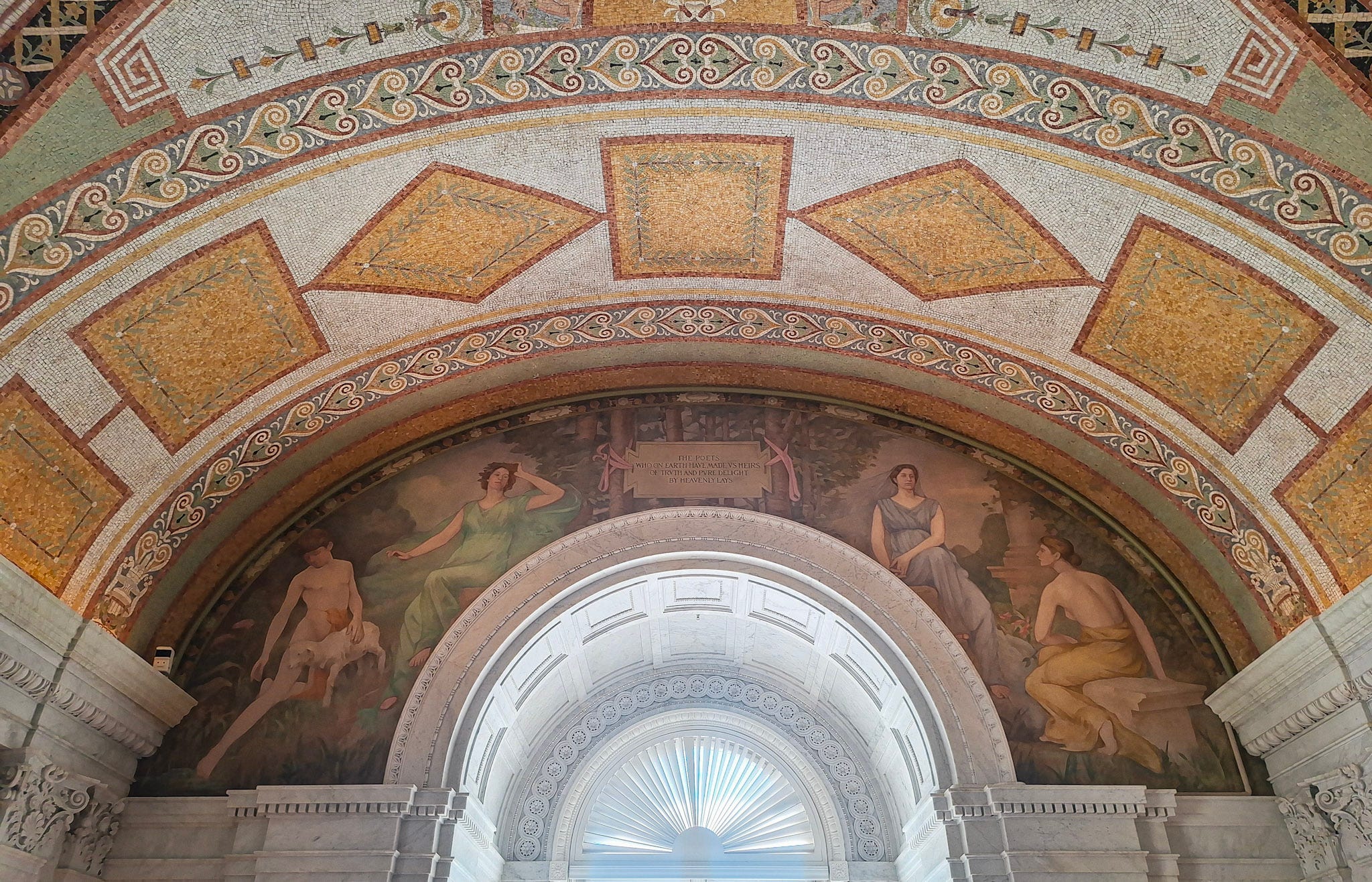
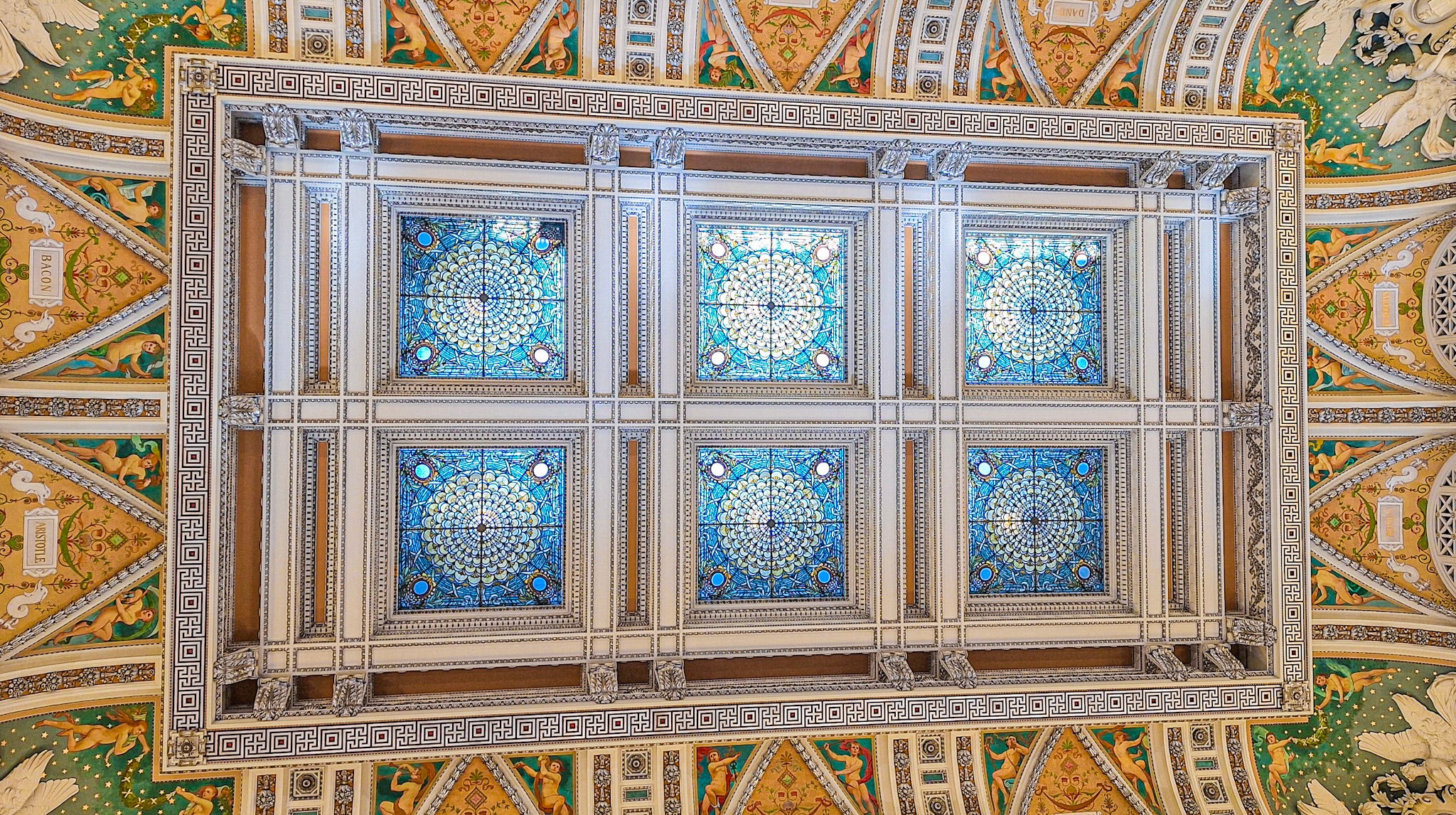
Last year, I met up with a friend in Washington D.C. during graduation season. After visiting the Museum of the Bible and grabbing lunch together, we parted ways and I eventually found my way to the Library of Congress. The Great Hall in America’s national library is gilded in gold and royal blue, adorned majestically with Corinthian columns, inscribed all over with names and quotes from luminous wordsmiths and educators of the past. It is one of the most beautiful interiors I’ve ever seen.
Also inside the Great Hall were scores of just-graduated students. Young men in those simple, non-descript black suits that seem to be the only thing available to young men looking for a suit. Young women, as well, in gowns so flamboyant they made one wonder whether the girls wearing them had earned the right to do so. They were everywhere—up and down the stairs, across the compass rose, on every balcony and by every window.
And what were they doing?
Taking pictures. Posing. With parents. With friends. With boyfriends. Group shots. Solos. Selfies. All of it. Incessantly. Completely ignoring the splendor around them.
But that isn’t entirely true.
See. They sensed the obvious beauty of their surroundings, how the afternoon sun filtering through the stained-glass skylights sacralized the aura in that hall.
But, in the context of this conversation, I still wonder if they really recognized beauty.
To speak of recognizing beauty is not to say that everyone must be a history buff to enjoy a historic structure. Or that only those who understand the ancient and intricate act of Persian tapestry-making just so can appreciate a beautiful Arabian rug.
I am questioning whether we, as a society, have the capacity to apprehend real beauty when we see it. To really take it in at a sub-intellectual level. Because, if we don’t, we are more lost than we think, and beauty as a construct is useless to save us.
Let’s relate this to the issue of second screen writing, a topic in the zeitgeist following Matt Damon and Ben Affleck openly speaking about Netflix requesting that movies and streaming series be written in a way that mollifies viewers’ short attention spans and scrolling-while-watching habits. Content made now must:
be fast paced and have a big action sequence closer to the beginning
have characters repeat the plot often (in case the viewer forgot)
have mild, easily understandable dialogue
also be able to exist as background noise without causing viewers to feel lost when they mentally tune back in
This scheme by Netflix (and other streamers?) caters to our current state of brainlessness, intellectual rot, and inability to focus on anything for longer than twelve seconds. As with AI (and learning music by TikTok), we are at the knife’s edge of entire generations being unable to watch, say, The Godfather because it’s too long, has a diverse plot, and uses words that might send one to a dictionary.
There may come a time when entire segments of cultural phenomena are neglected simply because we’ve become incapable of apprehending them.
Beauty, like a complicated Christopher Nolan film, may become gibberish.
It’s a good thing, then, that beauty conquers reason.
we cannot reason our way out
Beauty—the idea with which we are here concerned—is a magnet with a door. We are drawn to and into that which is beautiful—people, art, buildings, stories. We need no explainer or precursor. We are, often, unaware that it is happening.
Thus C.S. Lewis describes Psyche in Till We Have Faces:
[Hers] was beauty that did not astonish you till afterwards when you had gone out of sight of her and reflected on it. While she was with you, you were not astonished. It seemed the most natural thing in the world.
Unfortunately, we live in an excessively navel-gazey era. We can’t receive an experience without also receiving some kind of dialogue surrounding that experience or some conversation about what it means that we have had the experience that we’ve had. (And here we are talking about beauty.)
But real beauty, the door-and-magnet kind, draws one in without argument, without conversation. There is no negotiation with real beauty. Its un-negotiability is what makes it a transcendental and is also what puts us at a loss to comprehend it.
We don’t need to know what beauty means; we need to know the thing itself. And to know the thing itself, we must receive its answer without question. Beauty rebuffs questions. Or, better said, it ignores them, steps aside and lets them pass.
The Culturist, who has recently written on the matter, brings this out in the example of characters from The Brothers Karamazov and The Idiot. Alyosha, the protagonist of Brothers Karamazov, is very much like Prince Myshkin whom we discussed in my last post. Readers “are drawn to Alyosha and the kind of life that is lived out by his philosophy. He doesn’t have all the logical answers, but he lives oriented toward something that transcends the need for logical arguments in the first place.”
Further:
Beauty, like the characters of Alyosha and Myshkin, is living proof of a kind of truth that exists beyond the reach of logic. Beauty is something that you cannot be reasoned into or out of, and it simply grabs you.
None of this is to say that reason, logic, or intellectualism are bad. They are simply secondary when it comes to the question of whether we can perceive beauty and whether beauty can truly save us or our world.
two conversations
Let’s go back to the Great Hall of the Library of Congress. When we talk about beauty, we seem to have two different conversations going on. One conversation is about the impulse, desire, or even general mandate to make things visually appealing. (An impulse I fully support.) The other conversation is about the pillars that uphold beauty as transcendental and whether these pillars can be distilled by particular forms—like the forms which influenced the architecture of America’s capital.
I know enough to know that a Corinthian column is prettier than a concrete slab, but I struggle to explain why that matters. And when I attempt to do so, the column begins to feel like something foreign, ancient, and unbelonging to me. Something plucked from its timeline and thrust into our own. I become a foreigner to beauty, putting a blindfold on because I am trying to wrestle beauty into an intellectual frame that is not my own.
One of my chief irritations about the ‘beauty will save the world’ conversation is that it falls into modernity-hatred far too much for my liking. I am in this time and I want to appreciate what is beautiful about it. As an artist, I want to bring beautiful forms out of the matter of today—beauty that sings truly to ears here and now and for eternal tomorrows.
I do not raise The Library of Congress as an example because it is old, but because it is beautiful—and of a beauty that transcends age. A beauty that draws you to itself and into itself. That is what all those D.C.-area college graduates understood without knowing.
Again, The Culturist says it better than I could:
When you encounter something truly beautiful in life, you don’t stop to question its beauty or ask whether it’s meaningful or not. It has already impressed meaning upon you.
The question I ask (and fail to answer) is: will we be capable of apprehending the meaning beauty impresses upon us much longer?
Great thoughts here!