

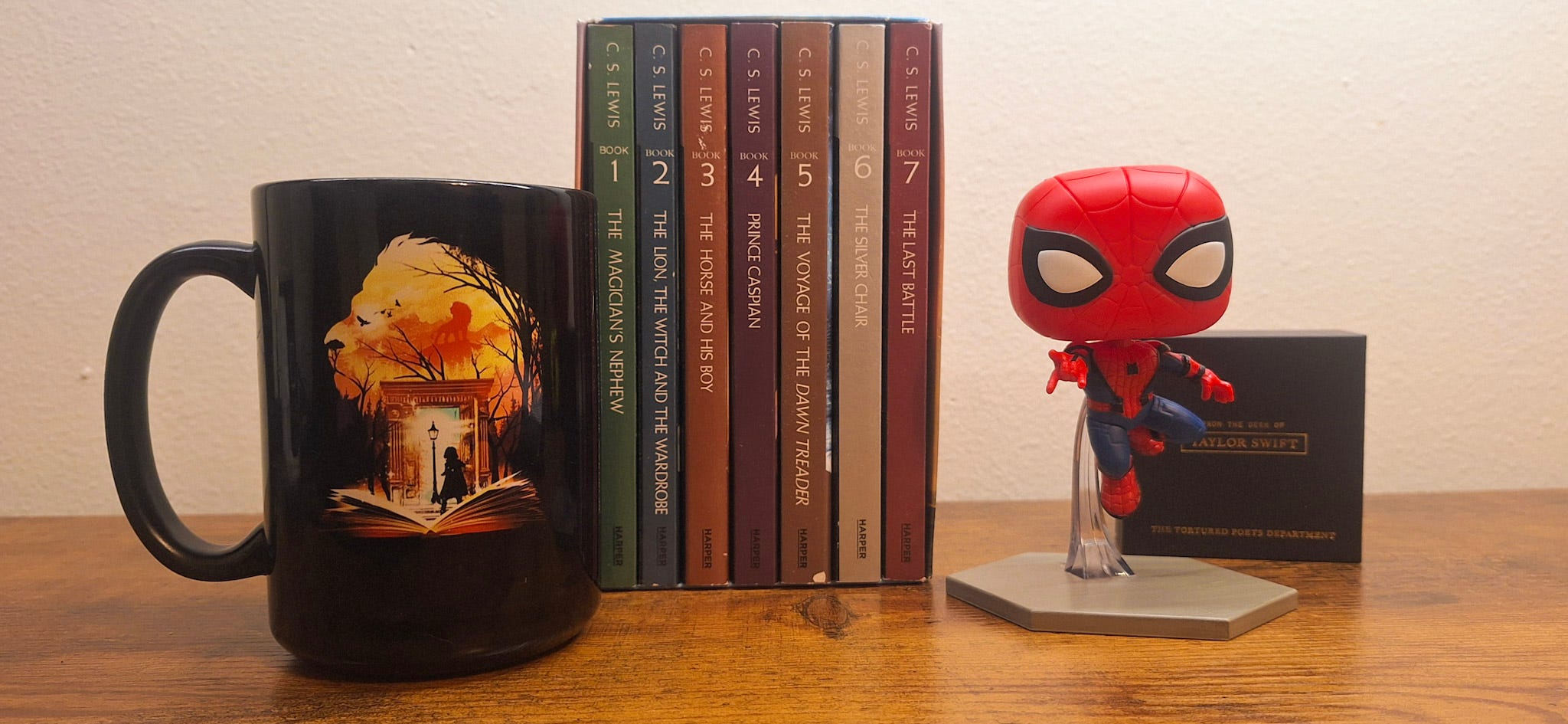
I’d be remiss if I let this weekend pass without acknowledging The Lion, the Witch, and the Wardrobe’s publication on 16 October 1950—75 years ago. C.S. Lewis’ children’s fantasy novel sits in a strangely revered position: it is popular and timeless but it hasn’t yet broken its confines and become merely an “intellectual property,” twisted, over-adapted, and under-interpreted in popular culture.
At least, not yet. Maybe it’s safe, protected by a strange magic of its own. Or maybe Greta Gerwig’s currently-filming adaptation of The Magician’s Nephew will change all that very soon.
Regardless, I happen to be doing my part to interpret and over-analyze the Narniad. The texts are significant to me and I use no hyperbole when I say The Lion, the Witch, and the Wardrobe changed my life.
Six years ago, I wrote a series of essays reflecting on each of the Narnia books as I re-read them all at once. Last month, a youth pastor in Georgia sent me a long DM expressing that he had unearthed those essays and was reading them alongside his re-read of The Chronicles of Narnia.
…I stumbled onto your articles about re-reading the books. And they have been so helpful to me and so encouraging and uplifting... The Lord has really used your articles to widen my understanding of the books and give me a deeper appreciation for them and for what Jesus has done.
I have not gone back to read those original essays in a long time. But I have continued to write about Narnia—some of which you can read at the links below.
There Are No Cruel Narnians: What The Horse and His Boy Can Tell Us About Racism, Cultural Superiority, Beauty Standards, and Inclusiveness
Wherever I Go, That’s Where the Party’s At: Prince Corin as C.S. Lewis’ Harbinger of Joy
(And I swear I’ll write The Lasaraleen Piece if it’s the last thing I do!)
Those seven original essays from 2019 are the sapling that led to my current work-in-progress, a fourteen-branch tree from which I’m sharing an excerpt below on this special occasion.
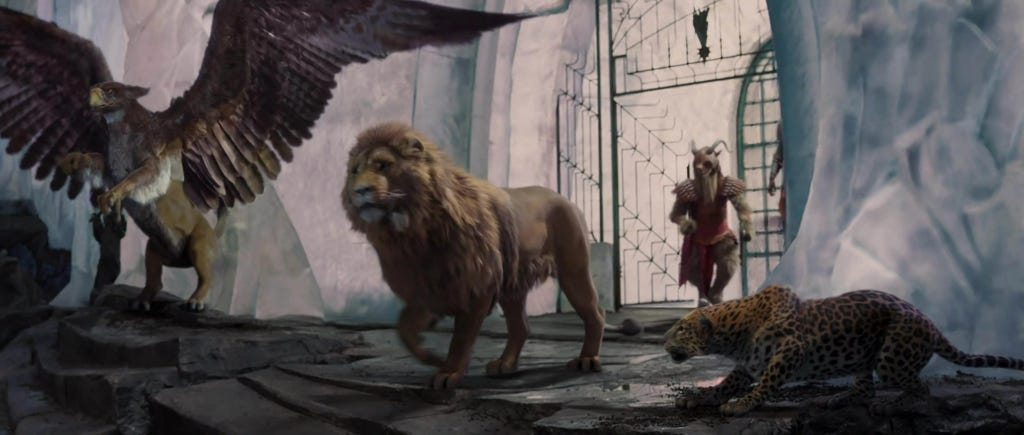
Real things and true things are not always the same. Your house is real. It’s solid; you can touch it. So are trees and the earth beneath your feet. Everything we can see and taste and touch—everything we’ve lived through—makes up our reality. But what if our reality is not all? What if here is not all there is?
Am I talking about aliens? Possibly. Life on other planets? Why not? Parallel universes? Definitely. A realm of spirits and ghosts, angels and demons? Absolutely.
A reality beyond our own is no less true simply because we have not experienced it. Our very ability to conceive of realities beyond our own is testament to the logic of such concepts. The fact that we can assume perfection, idealism, fulfilment, paradise—having not yet experienced these things—ought to tell us something. When we aren’t becoming frustrated with life in this world, we can dream of a better one.
Most of us spend our lives unattuned to the whisperings of Northernness and longing. We let the cares of this world extend their limbs around our hearts and minds, burying us in mechanics and utilitarianism. We see value only in what we do and the product of our labor. We, ourselves, become mere statistics—quantities over quality.
And, yet, not in the daylight, not in the well-lit places, not in the coffee shops and supermarkets, not on the commute to work or home, but in the quietness of dimmed bedrooms, in the afterglow of the latest Netflix episode, in the shower when the water’s gone cold and we are holed up with our fears and anxieties, we want to believe the myths. We want to believe that all the stories are true.
Creatures are not born with desires unless satisfaction for those desires exists. A baby feels hunger: well, there is such a thing as food. A duckling wants to swim: well, there is such a thing as water. Men feel sexual desire: well, there is such a thing as sex. If I find in myself a desire which no experience in this world can satisfy, the most probable explanation is that I was made for another world. If none of my earthly pleasures satisfy it, that does not prove that the universe is a fraud. Probably earthly pleasures were never meant to satisfy it, but only to arouse it, to suggest the real thing.1
A seed is in each of us. A question mark. And that seed is meant to flourish into a tree. The question has an answer.
Peter, Susan, and Edmund attempt to kill, in Lucy, the dream of another realm in which her little heart had already found a home. But the professor begs them to let the issue be. “We might all try minding our own business,” he says.
And if we all tried minding the business that is truly ours—not the nine-to-five or the demands of a career, not the obligations we must meet because our neighbors will look down on us if we don’t, not the obsession with what’s happening in others’ lives—if we nursed the little seed that’s worming about in our souls, we might find that longing growing larger and fiercer. Instead of quieting the natural demand for transcendent fulfilment, we might find that demand growing louder, and our attempts to satisfy that demand growing more serious and deliberate.
I must keep alive in myself the desire for my true country, which I shall not find till after death; I must never let it get snowed under or turned aside; I must make it the main object of life to press on to that other country and to help others to do the same.2
Don’t dismiss the whispers in your soul, the forlorn bees buzzing about the hive of your heart, demanding entrance. If you desire to enter another world, turn the doorknob. Don’t be scared. We hesitate to try the door because something tells us it’s unlocked.
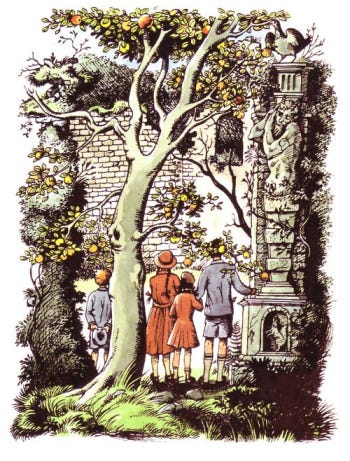
Now for some movie thoughts…
The past few months have been like 2007 and 2009 all over again, with Narnia movie news, casting rumors, and actual footage of actual filming taking place on location at various spots in England! Despite the rumored timeline shift, I remain optimistic that we’ll have a good Magician’s Nephew adaptation and that it will come with the groundwork for a long-standing Narnia film franchise.
I am mostly concerned about whether there is a plan in place for such a franchise. IMAX CEO Rich Gelfond seems to think Netflix is planning for as many movies as there are books. Not to get ahead of things, but what’s the plan for after The Magician’s Nephew? Is Gerwig willing to sign on to adapt another project beyond the two she’s set for? If not, will whoever takes over after her follow the same vision or go off and do their own thing?
There’s much to be revealed and November 2026 can’t get here fast enough. NarniaWeb has been doing amazing work covering developments. If you want to talk specific Narnia movie news, comments are open.
And for more Narnia…
Read my take on Greta Gerwig as a portal fantasy filmmaker here.
Read my friend Caleb Woodbridge’s reflections on Narnia at 75 below.

And Natasha Burge’s latest essay. (She has a good handful of writing on Narnia and Lewis which I’ve enjoyed at her substack, The Undercurrent.)

Chapter 10, Mere Christianity.
Chapter 10, Mere Christianity.
I think your essay on The Horse and His Boy was the first piece of your writing I read!
One thing I notice amongst my American or RR friends is how many seem to have had an almost Damascus road experience with the books. Having grown up with the bbc adaptations (I do not remember when I first watched VotDT) I think mine was more Emmaus road. I remember understanding Aslan’s sacrifice at a young age and it shaped so much of how I understood the cross. But it’s been a gentle road resulting in me finally reading all the books at the age of 30. It’s just weird to me how different the impact this one series can have yet be powerful for so many